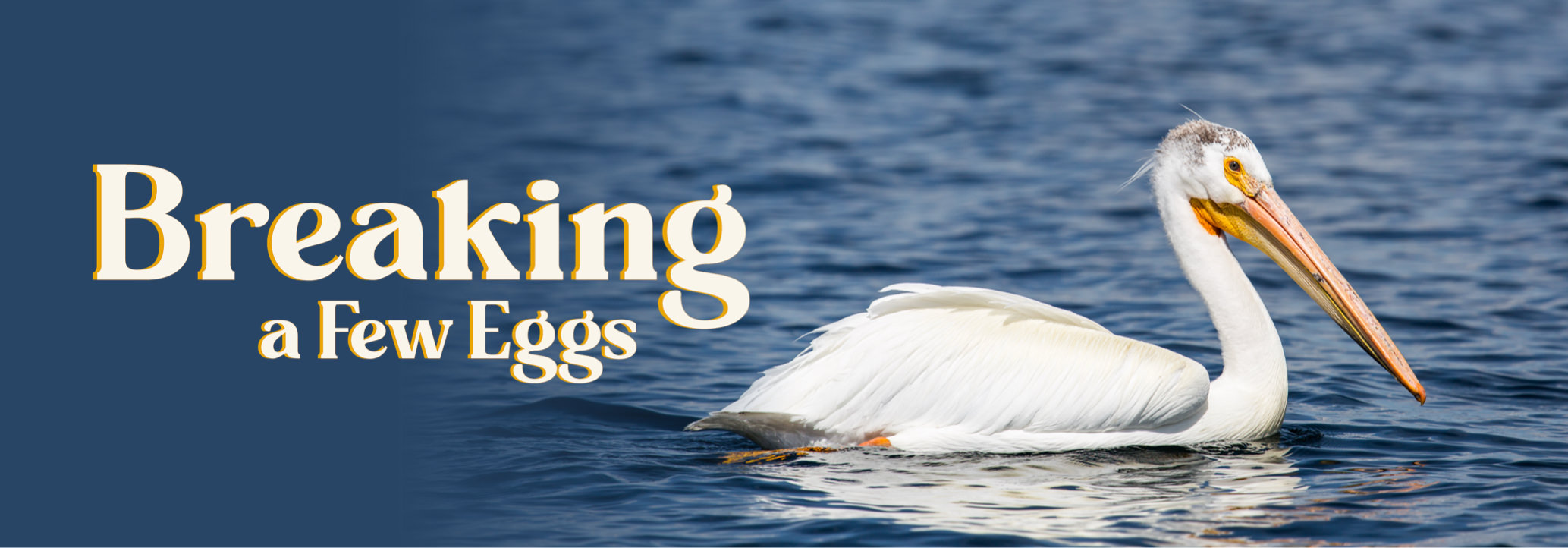
An American White Pelican on Yellowstone Lake. PHOTO COURTESY OF YELLOWSTONE NATIONAL PARK.

By Fischer Genau
In September of 1932, Mrs. Rosalie Edge of New York City, New York, composed a short letter to the national park service in Yellowstone. Written in her spacious apartment on Fifth Avenue, the pamphlet, titled “The Slaughter of the Yellowstone Park Pelicans,” would end up causing quite a stir. In it, Mrs. Edge alleged that park employees had been sneaking up on pelicans on the shores of Yellowstone Lake, clubbing them, and trampling their eggs. The park had denied claims of this nature, but Mrs. Edge had traveled to Yellowstone herself in her Ford coupe to investigate, questioning park officials and turning up damning internal documents intercepted by her network of eco-spies to prepare her report. That little pamphlet would spark controversy over the plight of Yellowstone’s pelicans and help change the way the park managed its wildlife for decades to come.
Pelicans are pretty far down the list of iconic animal species in Yellowstone National Park. The sight of one is more likely to inspire confusion than awe in a visitor, but the American White Pelican has been nesting in Yellowstone since the 1800s. Although the enormous snowy white waterbirds spend their winters on warm coastlines, they breed all over the American West, including the south arm of Yellowstone Lake. While there, pelicans guzzle down up to 40% of their body mass each day in prey, mostly Yellowstone cutthroat trout, and it was this voracious appetite that made the birds into villains.
In the 1930s, park officials saw the white pelicans nesting on the shores of Yellowstone Lake as a nuisance. “They’re hoggish,” one official said. “Even when they’re full, they go right on fishing and store up the catch in their bills. There’s nothing left for anybody else around here.” But Mrs. Rosalie Edge was not easily dissuaded. One of her friends, zoologist Dr. Van Name, called her “the only honest, unselfish, indomitable hellcat in the history of conservation.” She’d built a reputation fighting on the behalf of all kinds of overlooked and villainized creatures, including skunks, muskrats, snakes, woodchucks, coyotes, and mountain lions, and in a 1948 profile in the New Yorker, Robert Lewis Taylor wrote that “During a normal day, Mrs. Edge will compose between five and ten indignant letters—to newspapers, government officials, conservation groups that she considers dangerously inadequate, and mischievous individuals.”
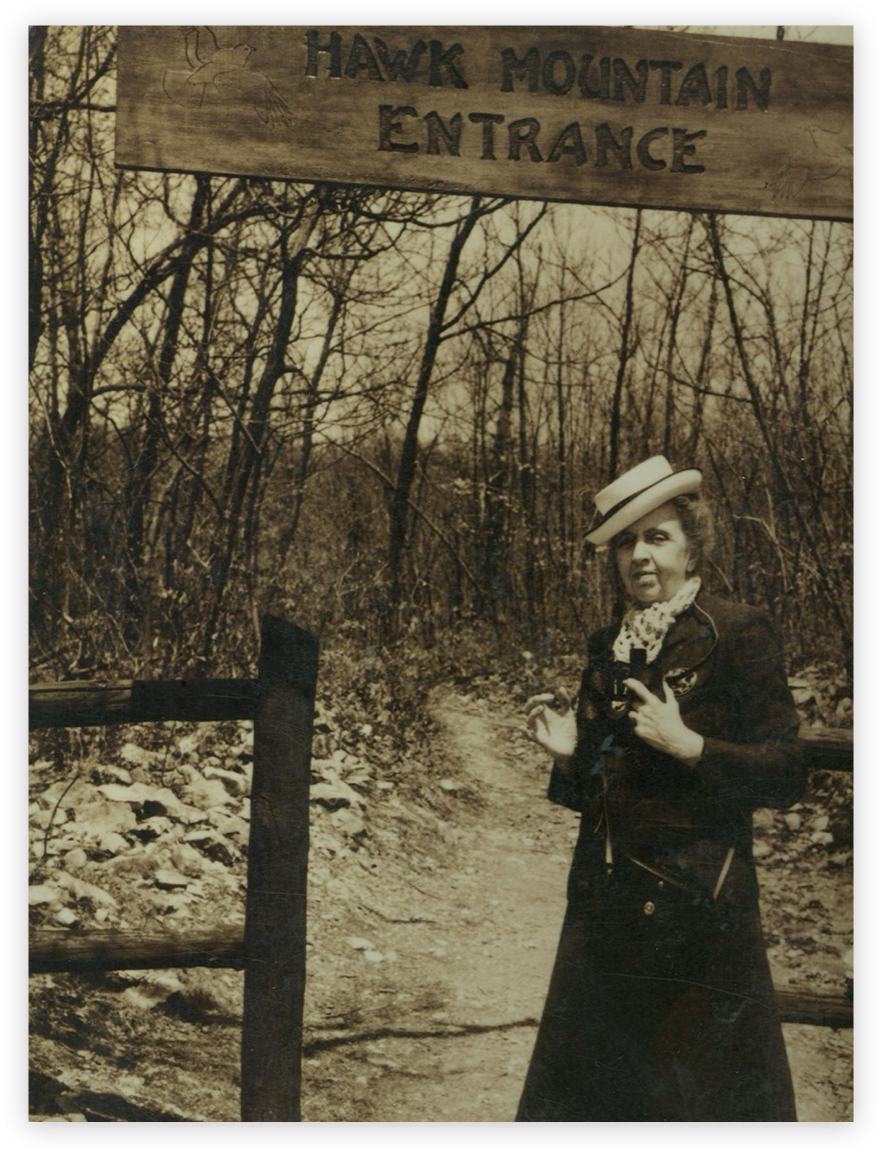
Rosalie Edge at the entrance to Hawk Mountain Sanctuary, an area she purchased and turned into a nature preserve after learning that hundreds of hawks were being gunned down there for sport. PHOTO COURTESY OF HAWK MOUNTAIN SANCTUARY.
Born into a family of English nobles, Edge used much of her fortune on her conservation campaigns, later saying that “while I do not regret one cent of it, I am now in comparatively straitened circumstances—for example, I need a new coat, but I propose to spend that money on a pamphlet about coyotes.” Edge put her inheritance and mettlesome nature to good use. She’s credited with establishing Olympic National Park in Washington, and she won hundreds of skirmishes with hunters, conservation groups, loggers, and other adversaries. Birds were her biggest preoccupation, having gotten involved in conservation after developing a feverish fascination with them in 1915, and Edge wasn’t budging on the matter of Yellowstone’s white pelican population.
In “The Slaughter of the Yellowstone Park Pelican,” Edge quoted an anonymous whistleblower who described rangers stomping on pelican eggs and clubbing chicks to death under orders from former Yellowstone Superintendent Horace M. Albright. This account, backed up by reports and correspondence pointing to a prolonged cover-up, directly contradicted a 1928 letter from superintendent Albright saying that no pelicans had been killed in the park, aside for a few scientific specimens. Edge ended the pamphlet by calling on readers to write to the U.S. Secretary of the Interior to protest the pelican’s slaughter.
In “The Slaughter of the Yellowstone Park Pelican,” Edge quoted an anonymous whistleblower who described rangers stomping on pelican eggs and clubbing chicks to death under orders from former Yellowstone Superintendent Horace M. Albright. This account, backed up by reports and correspondence pointing to a prolonged cover-up, directly contradicted a 1928 letter from superintendent Albright saying that no pelicans had been killed in the park, aside for a few scientific specimens. Edge ended the pamphlet by calling on readers to write to the U.S. Secretary of the Interior to protest the pelican’s slaughter.
A month later, Albright, who had been promoted to director of the National Park Service, sent a letter to the head of the Audubon Society, Gilbert Pearson, that said the pelican had received complete protection within the confines of Yellowstone National Park. In his 1999 book Preserving Yellowstone’s Natural Conditions: Science and the Perception of Nature, James A. Pritchard writes that “The controversy over the [Yellowstone] predator pelicans helped preserve the white pelican in North America, shaped wildlife management policy in Yellowstone, and… propelled Yellowstone and the National Park Service toward redefining the purposes of the parks.” Edge’s pamphlet appeared to have paid off.
The actual truth was a little more complicated. Apparently, in May of 1932, several months before Edge published her pamphlet, Yellowstone’s new superintendent Roger Toll decided to protect the Yellowstone Lake pelicans. However, this initial decision didn’t get any publicity, and Edge’s pamphlet ensured that protection for pelicans was publicized and enshrined for years to come.
The National Park Service has evolved dramatically since the days of Rosalie Edge. It is now common knowledge that predatory species like wolves, mountain lions, coyotes, and pelicans play essential roles in an ecosystem, and they are protected just like any other animal. Firecrackers like Mrs. Edge helped bring their plight to the public, and through tenacity, wit, and courageous disagreeableness, made sure that they were safe to live, nest, and gobble up trout in the heart of Yellowstone National Park.