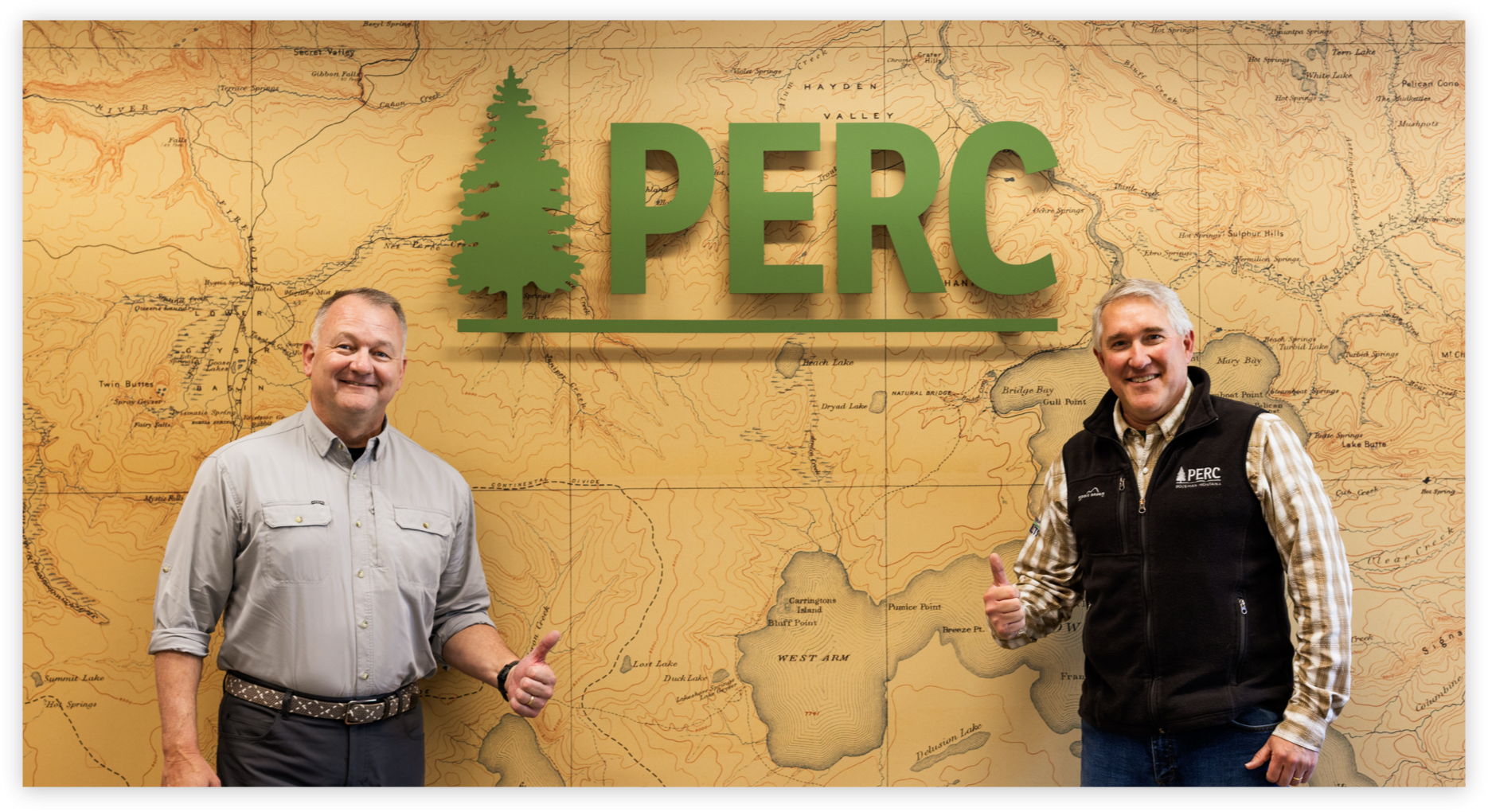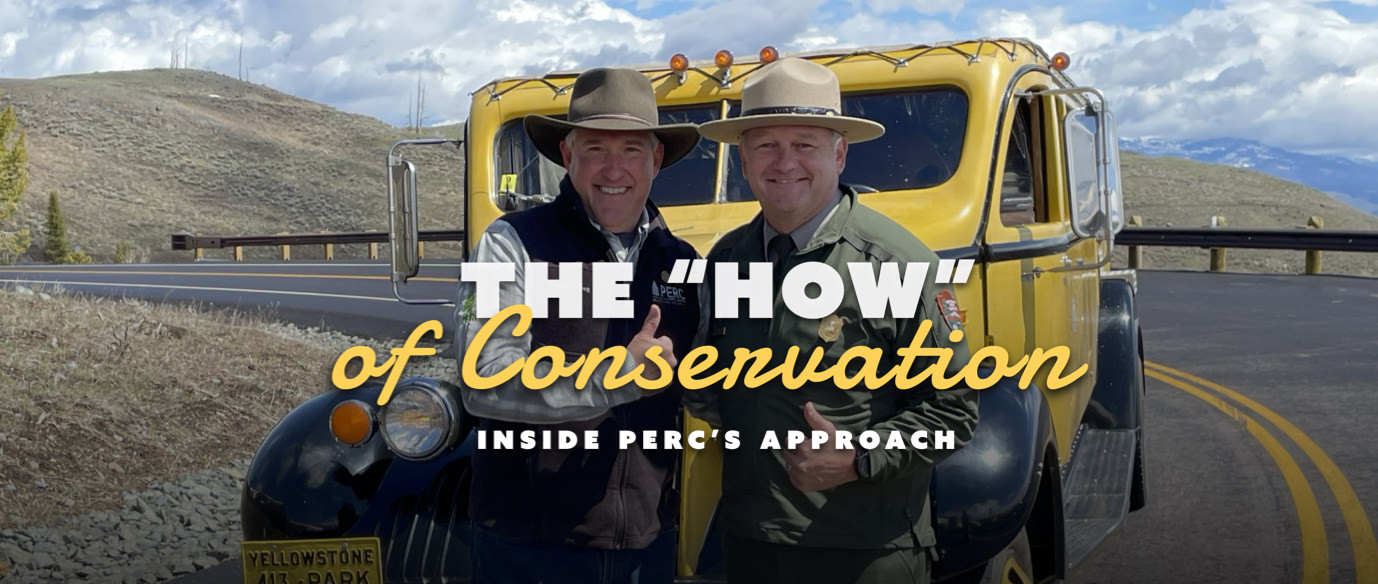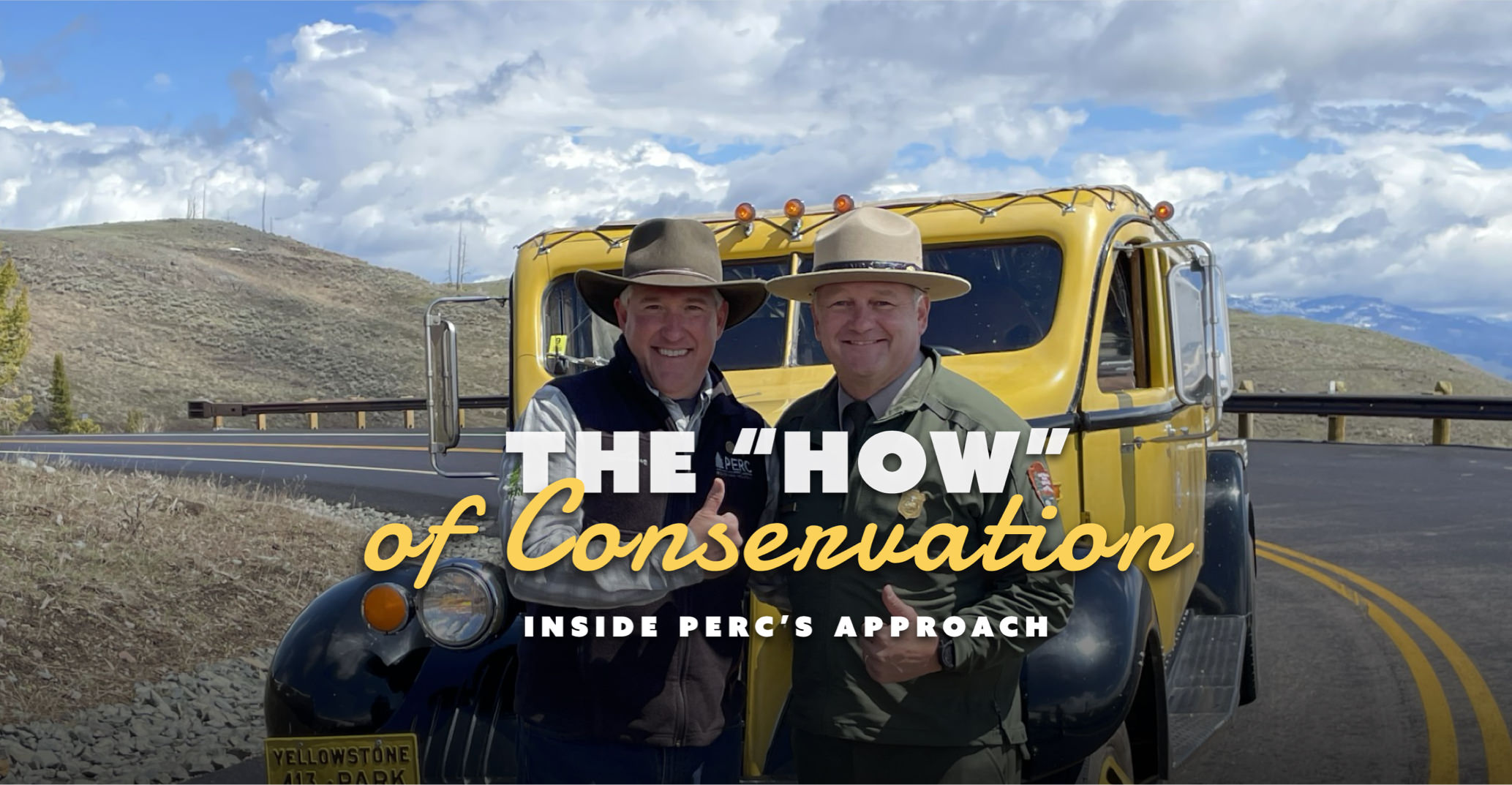
PERC CEO Brian Yablonski (left) with Yellowstone National Park Superintendent Cam Sholly (right) at the park’s 150th anniversary ceremony in the spring of 2022. Photo courtesy of PERC

By Claire Cella
I found out quite quickly that it only takes one brief conversation about the Property and Environment Research Center to understand that … and please, pardon the pun, but … there are perks to partnering with PERC.
Take Cam Sholly, superintendent of Yellowstone National Park, for instance. Before I asked any questions, Sholly had already launched into praise. “They’re just a really good group,” he said. “They convene the right people, the right perspectives. They’ve got the expertise to do the analysis to develop a position, to mobilize quickly. Their team is one of the best that I’ve ever seen.”
PERC is a nonprofit conservation organization based in Bozeman, Montana, helmed by Brian Yablonski as chief executive officer and a team of 25 experts in conservation, research, communications, policy, and law. What distinguishes PERC from other conservation nonprofits in the Rocky Mountain West, and arguably the country, is their focus on the how of their work, Yablonski said.
Take Cam Sholly, superintendent of Yellowstone National Park, for instance. Before I asked any questions, Sholly had already launched into praise. “They’re just a really good group,” he said. “They convene the right people, the right perspectives. They’ve got the expertise to do the analysis to develop a position, to mobilize quickly. Their team is one of the best that I’ve ever seen.”
PERC is a nonprofit conservation organization based in Bozeman, Montana, helmed by Brian Yablonski as chief executive officer and a team of 25 experts in conservation, research, communications, policy, and law. What distinguishes PERC from other conservation nonprofits in the Rocky Mountain West, and arguably the country, is their focus on the how of their work, Yablonski said.
“A lot of conservation groups are where groups—there’s a geographic location they’re working within—or what groups—there’s a species or an issue they’re working for—or who groups—their membership is a certain group, like hunters and anglers,” Yablonski said. “At PERC, we believe how you do conservation matters significantly, and our how approach is based on using incentives, property rights, and market tools that make economic sense to, in turn, make conservation more durable and innovative.”
PERC was founded in the 1980s by a group of conservation-minded economists who wondered if capitalism could produce things like bread and cars, couldn’t it also produce conservation? The driving force behind PERC’s mission, Yablonski said, was trying to figure out how to use capitalism and markets as tools for good. The founders went on to create an entirely new framework for conservation called free market environmentalism—where creative approaches are taken to ensure that environmental quality and the bottom line are not antithetical to one another, that exchanges can be cooperative, mutually beneficial, and produce sustainable environmental outcomes.
PERC was founded in the 1980s by a group of conservation-minded economists who wondered if capitalism could produce things like bread and cars, couldn’t it also produce conservation? The driving force behind PERC’s mission, Yablonski said, was trying to figure out how to use capitalism and markets as tools for good. The founders went on to create an entirely new framework for conservation called free market environmentalism—where creative approaches are taken to ensure that environmental quality and the bottom line are not antithetical to one another, that exchanges can be cooperative, mutually beneficial, and produce sustainable environmental outcomes.
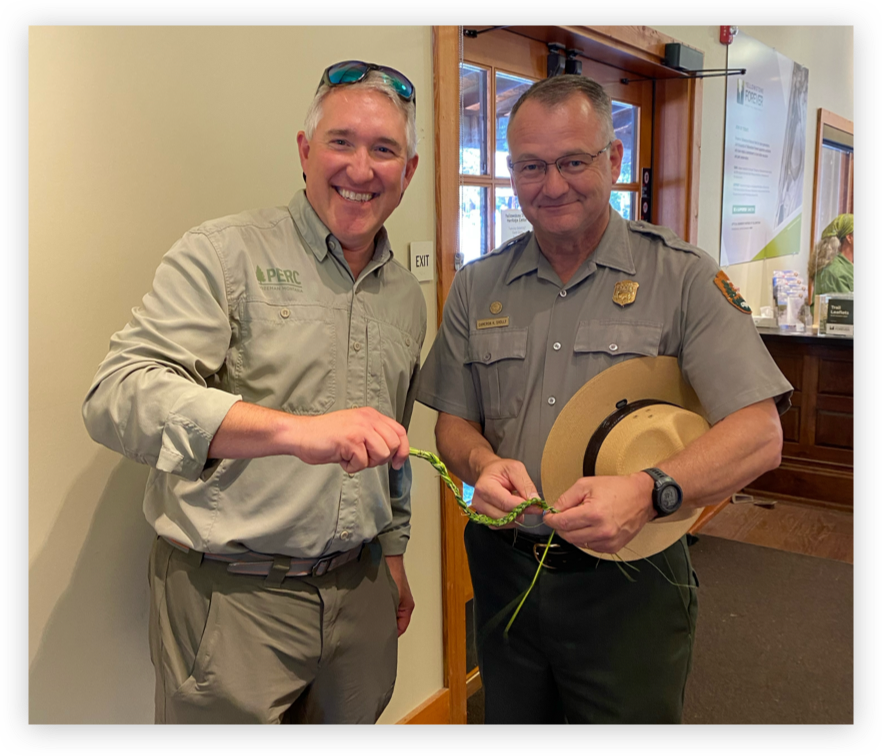
PERC CEO Brian Yablonski (left) with Yellowstone National Park Superintendent Cam Sholly (right) at the park’s 150th anniversary ceremony in the spring of 2022. Photo courtesy of PERC
In current practice, this involves what Yablonski called PERC’s three legs of a stool—a research center, a law and policy center, and a Conservation Innovation Lab. PERC employs a team of in-house researchers, natural resource economists, and law professors—in addition to contract researchers and fellows from across the country—who tackle questions ranging from how to reform and enhance the Endangered Species Act to encourage species recovery to how virtual fencing can be used to help reduce wildlife conflicts on working ranches. Their research serves as the foundation for policy reform and legal defense, where they center voluntary conservation practices and economic incentives for conservation, and funnels into the Conservation Innovation Lab, where research ideas are applied in the field at ranches, national parks, and in local communities.
Yablonski said PERC’s aim is to make conservation an asset, and not a liability. An example of this is found in the interface between migratory wildlife and private lands. When wildlife move from their higher summer ranges onto ranch lands in the winter, they can do damage: eating hay, bringing diseases such as brucellosis, leading predators to domestic herds, or damaging fences.
This is where PERC stepped in, working to find and create incentives for ranchers to continue providing this critical habitat for wild animals. In Wyoming and Montana, this looks like the East Yellowstone and Paradise Valley Brucellosis Compensation Funds, respectively, which compensate cattle ranchers in these regions who provide winter habitat for elk—but as a result, risk their herds contracting brucellosis. Over the course of a few years, PERC’s researchers listened to the ranching community’s challenges, convened working groups with other conservation groups, state wildlife agencies, and ranchers to discuss obstacles and opportunities, and provided recommendations for potential solutions. These funds are the result—a privately-financed tool that covers 75 percent of a rancher’s quarantine-related costs following a positive brucellosis test and makes it possible for them to protect both the region’s wildlife and their domestic herds.
Yablonski said PERC’s aim is to make conservation an asset, and not a liability. An example of this is found in the interface between migratory wildlife and private lands. When wildlife move from their higher summer ranges onto ranch lands in the winter, they can do damage: eating hay, bringing diseases such as brucellosis, leading predators to domestic herds, or damaging fences.
This is where PERC stepped in, working to find and create incentives for ranchers to continue providing this critical habitat for wild animals. In Wyoming and Montana, this looks like the East Yellowstone and Paradise Valley Brucellosis Compensation Funds, respectively, which compensate cattle ranchers in these regions who provide winter habitat for elk—but as a result, risk their herds contracting brucellosis. Over the course of a few years, PERC’s researchers listened to the ranching community’s challenges, convened working groups with other conservation groups, state wildlife agencies, and ranchers to discuss obstacles and opportunities, and provided recommendations for potential solutions. These funds are the result—a privately-financed tool that covers 75 percent of a rancher’s quarantine-related costs following a positive brucellosis test and makes it possible for them to protect both the region’s wildlife and their domestic herds.
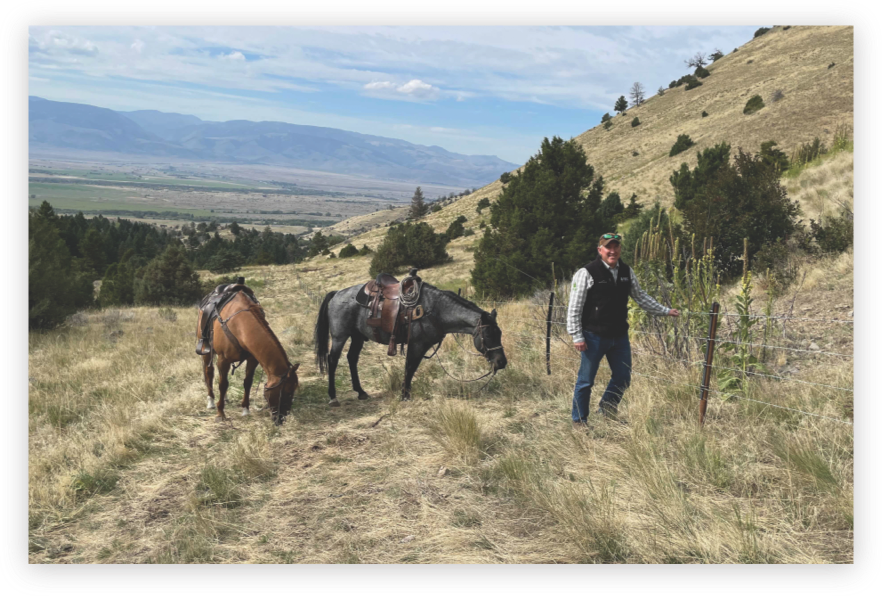
Brian Yablonski checks in on wildlife-friendly fencing PERC funded on the Petrich Ranch in Paradise Valley to help facilitate elk migration while reducing conflict with cattle. Photo courtesy of PERC
This is where Sholly said PERC shines—in their creation of good, strong relationships with and between divergent stakeholders, such as landowners, communities, universities, other nonprofits, and congressional delegations.
“I think that’s really novel,” Sholly said. “There are other nonprofits out there doing great work, but I really do think [PERC] has been at the tip of the spear in a lot of ways, in engaging with people that may have otherwise not necessarily been super interested in conservation. His team brings them to the table to figure out, ‘How can we work together?’”
“And those are all real-life problems,” Sholly added, “and things that have to be creatively thought through for us to be able to piece together the components of this ecosystem that make it what it is. They care, like we all do, about the strength of the GYE as an ecosystem, and the interface that has to occur between.”
“I think that’s really novel,” Sholly said. “There are other nonprofits out there doing great work, but I really do think [PERC] has been at the tip of the spear in a lot of ways, in engaging with people that may have otherwise not necessarily been super interested in conservation. His team brings them to the table to figure out, ‘How can we work together?’”
“And those are all real-life problems,” Sholly added, “and things that have to be creatively thought through for us to be able to piece together the components of this ecosystem that make it what it is. They care, like we all do, about the strength of the GYE as an ecosystem, and the interface that has to occur between.”
And while PERC is national in scope—spanning research on orca fertility in the Salish Sea to surveys of old-growth forests in Maine—having the Greater Yellowstone Ecosystem in their backyard has meant it has become ground zero for a lot of their work, Yablonski said.
And over the years, Yellowstone National Park has become one of PERC’s prominent local partners. Since 2018, they’ve worked together to address five substantive issues in the park: thinking creatively about streams of revenue, especially those tied to visitation; tackling the park’s deferred maintenance backlog; improving employee housing; navigating transboundary wildlife issues; and managing the aftermath of the 2022 floods.
One of the first issues to become apparent to Sholly upon assuming his role was the horrible conditions of the park’s employee housing—a mix of mostly trailers built between 1960 and 1983 that hadn’t been renovated in decades.
Yablonski said PERC helped Sholly and other park employees brainstorm solutions, such as replacing outdated trailers with high-quality modular homes, and advocating for the need in Washington D.C. Their work was further aided in 2024 by a $40 million gift that allowed the park to build 70 new modular units. Today, in early 2026, Sholly said the park has replaced or flipped half of its housing inventory.
And over the years, Yellowstone National Park has become one of PERC’s prominent local partners. Since 2018, they’ve worked together to address five substantive issues in the park: thinking creatively about streams of revenue, especially those tied to visitation; tackling the park’s deferred maintenance backlog; improving employee housing; navigating transboundary wildlife issues; and managing the aftermath of the 2022 floods.
One of the first issues to become apparent to Sholly upon assuming his role was the horrible conditions of the park’s employee housing—a mix of mostly trailers built between 1960 and 1983 that hadn’t been renovated in decades.
Yablonski said PERC helped Sholly and other park employees brainstorm solutions, such as replacing outdated trailers with high-quality modular homes, and advocating for the need in Washington D.C. Their work was further aided in 2024 by a $40 million gift that allowed the park to build 70 new modular units. Today, in early 2026, Sholly said the park has replaced or flipped half of its housing inventory.
“Sholly elevated employee housing as a priority for the park—moving it from not just a backburner maintenance issue, but to a core conservation priority,” Yablonski said. “The way we think about employee housing is that conservation starts by first taking care of the people who do the work of conservation. Sholly was smart enough to recognize that if you want good conservation, you’ve got to get the best conservationists. And that means putting them in habitable facilities.”
Another area where PERC and YNP worked closely together was in exploring increased visitor fees as a potential means to bolster the park’s revenue stream. Earlier this year, some of that research was put into effect when a new $100 surcharge on foreign visitors was applied in Yellowstone and 10 other of the most visited national parks. The revenue generated from the fees will go right back to the parks to help with deferred maintenance on crucial systems that keep the park running, such as infrastructure and wastewater systems.
In June 2025, PERC and its economists released a report that analyzed how much consumer behavior would change in response to a change in the price of visiting Yellowstone—something called price elasticity of demand. What they found was that the demand to visit Yellowstone is highly inelastic, suggesting that Yellowstone could modestly increase fees without significantly impacting visitation. In the study, they even used a hypothetical example of the $100 surcharge for international visitors, citing that it would raise $55.2 million while seeing only a 1.3 percent drop in visits. For a park with a $1.5 billion maintenance backlog, this idea seemed to offer a sensible and practical way for the park to fund its needs without significantly impacting visitation.
Another area where PERC and YNP worked closely together was in exploring increased visitor fees as a potential means to bolster the park’s revenue stream. Earlier this year, some of that research was put into effect when a new $100 surcharge on foreign visitors was applied in Yellowstone and 10 other of the most visited national parks. The revenue generated from the fees will go right back to the parks to help with deferred maintenance on crucial systems that keep the park running, such as infrastructure and wastewater systems.
In June 2025, PERC and its economists released a report that analyzed how much consumer behavior would change in response to a change in the price of visiting Yellowstone—something called price elasticity of demand. What they found was that the demand to visit Yellowstone is highly inelastic, suggesting that Yellowstone could modestly increase fees without significantly impacting visitation. In the study, they even used a hypothetical example of the $100 surcharge for international visitors, citing that it would raise $55.2 million while seeing only a 1.3 percent drop in visits. For a park with a $1.5 billion maintenance backlog, this idea seemed to offer a sensible and practical way for the park to fund its needs without significantly impacting visitation.

PERC CEO Brian Yablonski (left) visiting with ranching partner Druska Kinkie of Emigrant Peak Ranch. PERC has worked with Kinkie on a payment for presence program for elk on her property. Photo courtesy of PERC
“I think it was a great decision, and we’re looking forward to implementing it,” Sholly said. “Every American pays something in taxes to the greatest national park system in the world, and international visitors don’t. This same model exists in many places around the world—and PERC has been right there, advocating for that.”
These two examples in Yellowstone are emblematic of the types of projects PERC seeks out and stewards—research with outcomes, not just outputs, and where they think their research will lead to real-world conservation, Yablonski said.
As he looks ahead, Yablonski says he sees both challenges and opportunities for PERC and the GYE—often in the same issue. He thinks it will be crucial to find solutions that prevent fragmentation and development on private lands while also meeting landowners where they are and helping to support their viability. With public lands, he believes we’ll have to get our arms around the issue of loving our lands to death and figure out a way to conserve them while also enjoying them.
He believes the market can help be a part of the solution in both cases. “People are moving here for the things we want to conserve,” he said. “They aren’t here to extract oil and gas or jumpstart the timber industry, they’re here for our open space, our unique wildlife, our vast public lands.” In that, he sees an opportunity—people may be willing to pay for the resources to keep land intact, vistas open, and trails managed.
Ultimately, he said, conservation is a verb. “You have to do it. It just doesn’t happen on its own. It needs help.”
And PERC will remain one of conservation’s staunchest advocates, in the GYE and further afield, dedicated to helping bring people together to answer the next question when moving forward: how?
These two examples in Yellowstone are emblematic of the types of projects PERC seeks out and stewards—research with outcomes, not just outputs, and where they think their research will lead to real-world conservation, Yablonski said.
As he looks ahead, Yablonski says he sees both challenges and opportunities for PERC and the GYE—often in the same issue. He thinks it will be crucial to find solutions that prevent fragmentation and development on private lands while also meeting landowners where they are and helping to support their viability. With public lands, he believes we’ll have to get our arms around the issue of loving our lands to death and figure out a way to conserve them while also enjoying them.
He believes the market can help be a part of the solution in both cases. “People are moving here for the things we want to conserve,” he said. “They aren’t here to extract oil and gas or jumpstart the timber industry, they’re here for our open space, our unique wildlife, our vast public lands.” In that, he sees an opportunity—people may be willing to pay for the resources to keep land intact, vistas open, and trails managed.
Ultimately, he said, conservation is a verb. “You have to do it. It just doesn’t happen on its own. It needs help.”
And PERC will remain one of conservation’s staunchest advocates, in the GYE and further afield, dedicated to helping bring people together to answer the next question when moving forward: how?