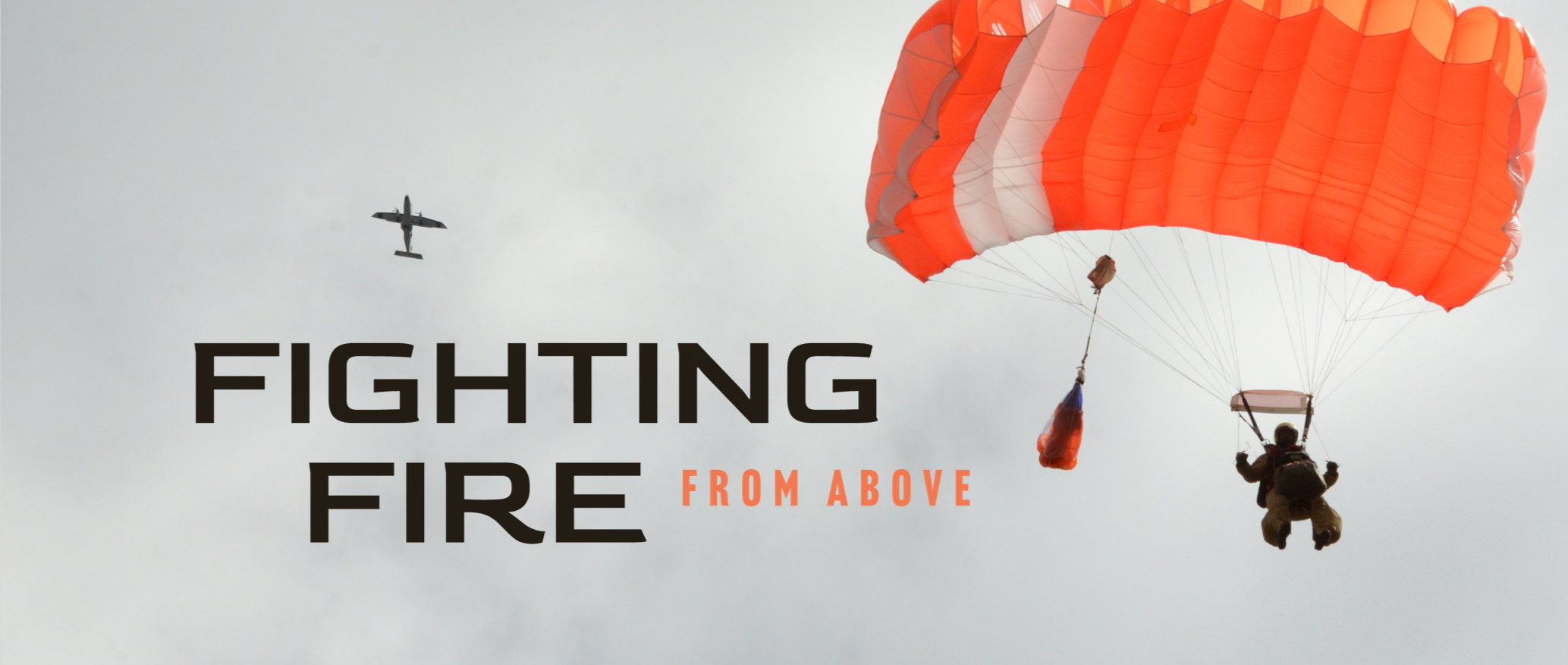
A West Yellowstone Smokejumper performs a proficiency jump east of Hebgen Lake. Gallatin National Forest, Hebgen Lake District. USDA Forest Service, Photo by Sam Duffey

By Taylor Owens
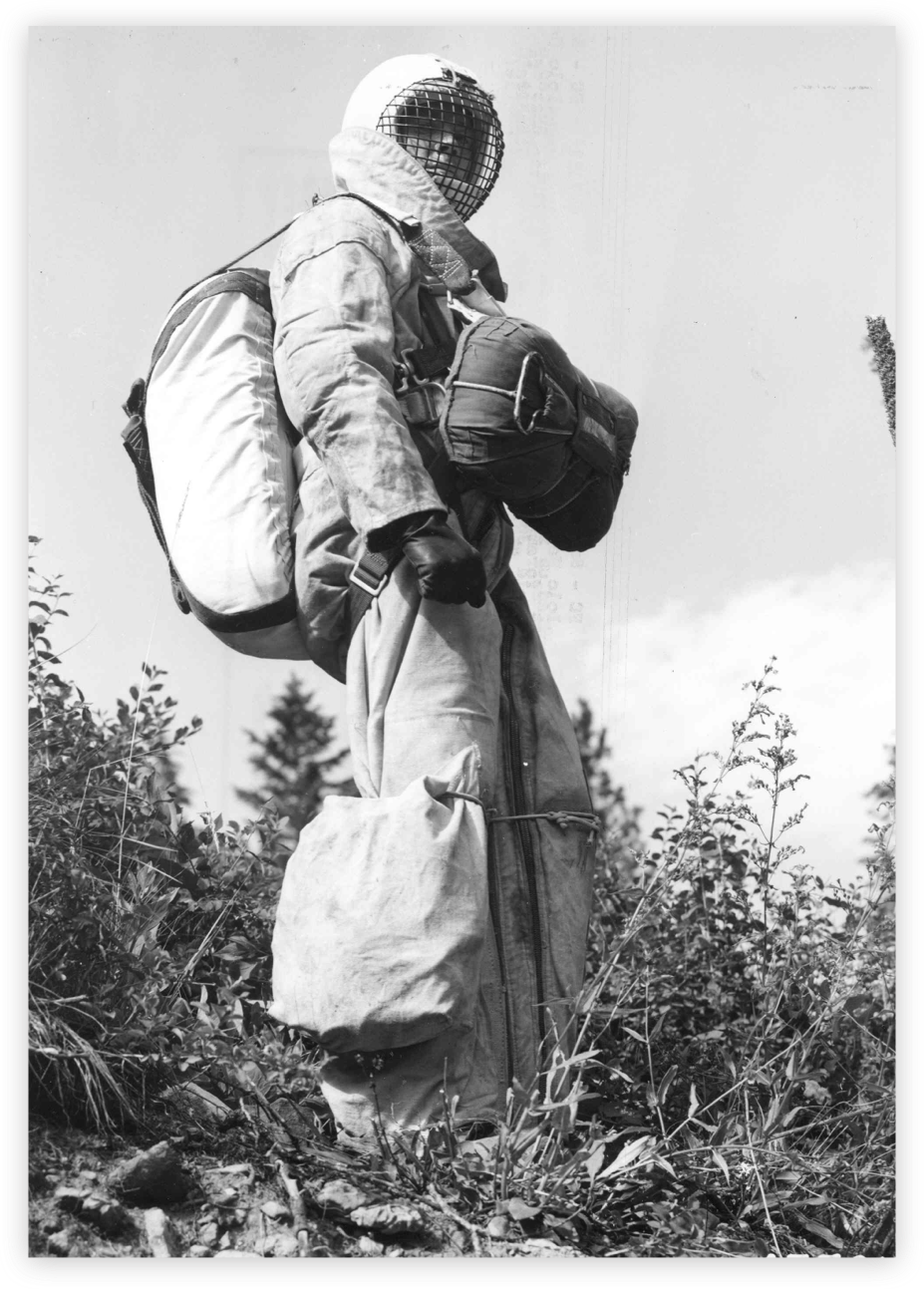
Smokejumpers - equipment. 1954. Lolo National Forest, Photo by WE Steuerwald
If you were to have stepped into Yellowstone National Park in late August 1988—a time period marked by a series of monthlong wildfires today known as the Yellowstone fires—the surrounding atmosphere would have been a surreal, bruised shade of orange. The sky would have been completely choked by a thick blanket of smoke, reducing the midday sun to an eerie red circle, the forest filled with a deafening freight train roar of 60 mile-an-hour winds that whipped through the valleys and vibrated through the soles of your boots. Century-old lodgepole pines violently exploded into towering walls of flame right before your eyes. You’d feel the blistering radiant heat hit your face like an open oven, even from hundreds of yards away, while burning embers are launched miles ahead to spark new blazes.
While the park was devoid of visitors—officials had closed it to non-emergency personnel on Sept. 8, 1988 for the first time in history—amidst the chaos, you’d see fire crews working frantically to douse the roof of the historic Old Faithful Inn, while herds of calm elk stand knee-deep in the Madison River.
Yellowstone was experiencing the largest wildfire in its recorded history, fueled by a series of fires that began in June, drought and high winds, and the West Yellowstone smokejumper crew were heavily involved in the fighting of the massive inferno. The Yellowstone fires burned for months, almost destroying two major visitors’ destinations.
When you visualize a wildland firefighter, maybe your mind conjures images of people dressed in heavy gear, carrying equipment through deep woods and forest, traversing mountain ranges and pushing back a fire on foot; rarely does the idea of firefighters parachuting from the sky come to mind. Helicopters dropping flame retardant maybe, but men?
Smokejumping is the practice of highly trained wildland firefighters parachuting from aircraft directly into remote, inaccessible areas to combat wildfires at their earliest stages. Their focus is on suppressing blazes before they grow large enough to threaten lives, property, or vast ecosystems.
The West Yellowstone Smokejumper Base was established in 1951 as a seasonal crew installed by the National Park Service and officially transitioned to a U.S. Forest Service-operated base in 1955. Now located at the Yellowstone Airport, this crew provides quick initial attack responses for wildland fires across Yellowstone and Grand Teton national parks, the Custer Gallatin and Caribou-Targhee national forests, and other regional assignments as needed. It serves as one of seven of the nation’s active United States Forest Service smokejumper bases (alongside two Bureau of Land Management bases), housing a dedicated team of about 28 smokejumpers.
Most of a smokejumper’s season doesn’t look anything like 1988.
Most days of their season start with an 8 a.m. roll call.
That’s when the crew sets the day’s “load”—the rotating jump list that determines who’s next out the door. The first eight names on the list are the ones who load the plane if a fire call comes in; once they jump a fire and return, they move to the bottom of the list, and the rotation starts again. After roll call, there’s time to work out and catch up on administrative duties before a morning briefing, where the crew reviews base operations, checks on nationwide fire activity, and studies the day’s weather to get a sense of how, and where, a fire might behave.
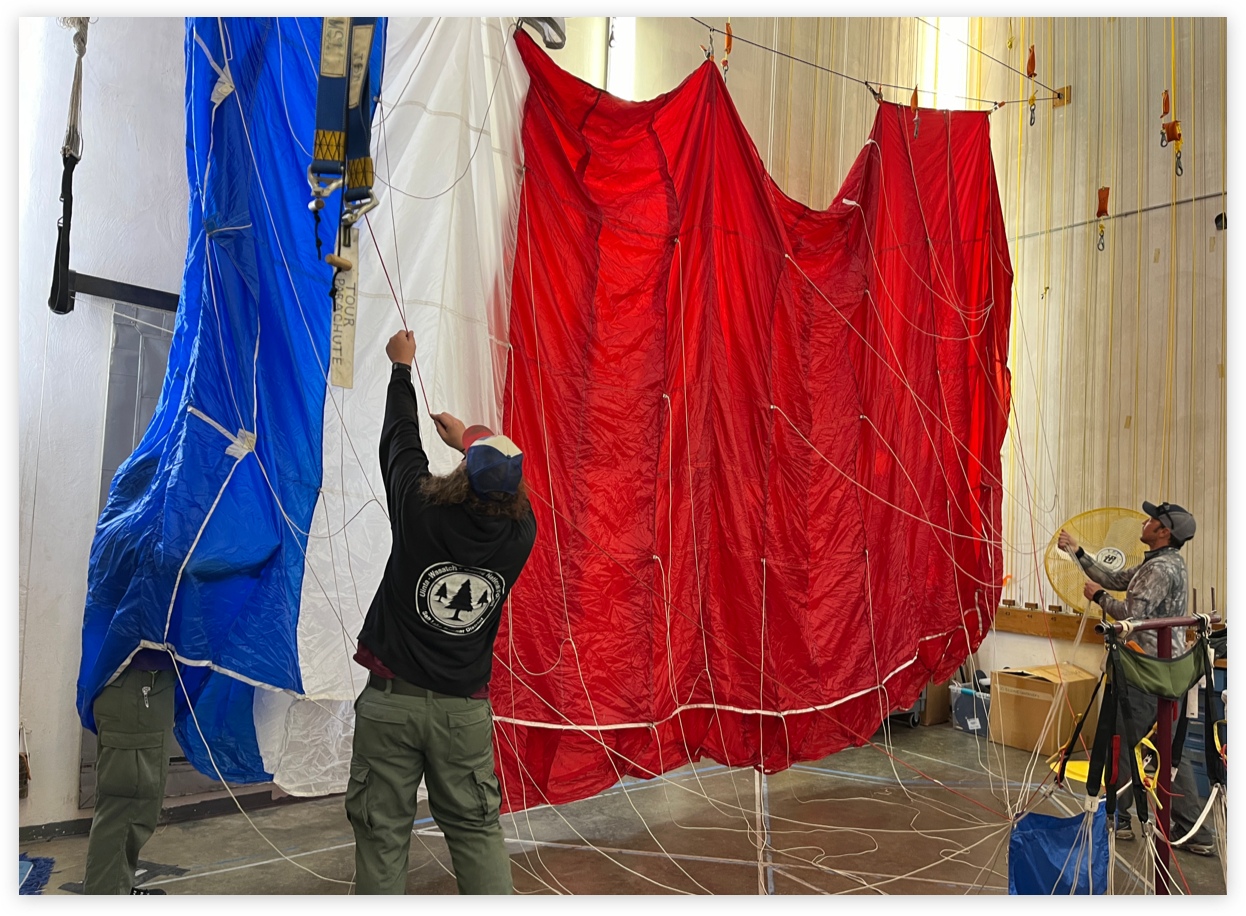
Smokejumper spring training. Photo courtesy of Forest Service Northern Region
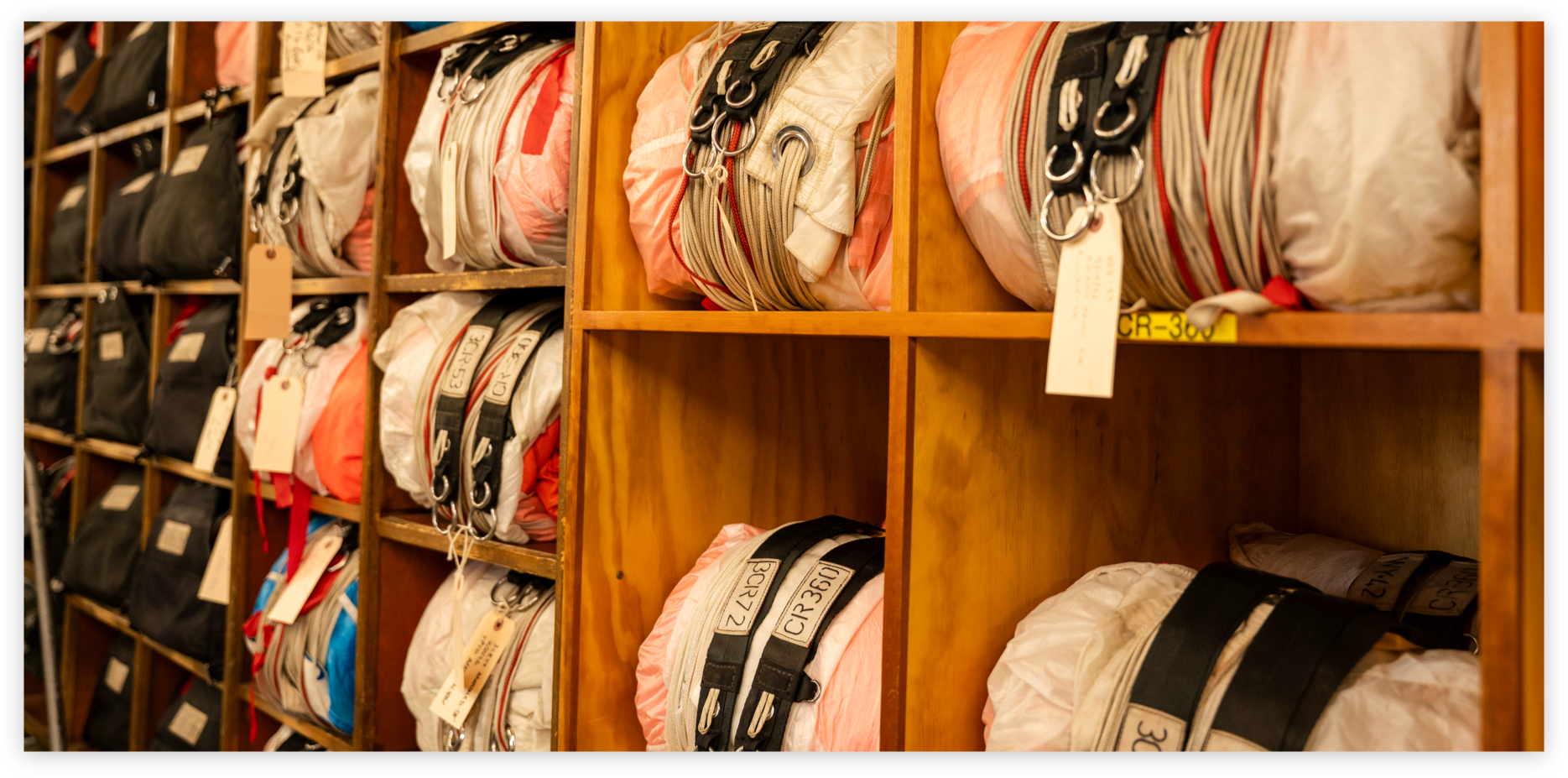
To stay proficient, jumpers get a practice jump every-other week, but a lot of the job happens on the ground: rigging and repairing parachutes in the loft, building cargo loads, refurbishing chainsaws, maintaining gear. As West Yellowstone Smokejumper Nathaniel Leahy put it, “There’s always something that needs to be done.”
What makes West Yellowstone distinct is that nobody commutes home at the end of the day—everyone lives at the base for the season. “In the evenings, people cook together, sit around the campfire and spend time together,” Leahy said. “It really does feel like summer camp.”
What makes West Yellowstone distinct is that nobody commutes home at the end of the day—everyone lives at the base for the season. “In the evenings, people cook together, sit around the campfire and spend time together,” Leahy said. “It really does feel like summer camp.”
On a fire, the day looks pretty different. Usually, the rookies are up early and have coffee going by 6 a.m. People eat breakfast, organize their gear, and get ready for the day. Most jumpers come into the program with a lot of previous fire experience, so everyone generally has a good sense of what needs to happen operationally. The Jumper in Charge (JIC)—the crew’s designated on-ground leader—will then give a quick briefing and lay out the plan for the day.
From there, people head out of camp and get to work. The job can change quickly depending on how the fire is behaving and available resources. One day you might be cutting line—clearing away brush and digging down to bare dirt to stop the fire in its tracks—and the next could be running a pump, working with helicopters, scouting terrain, or helping build a plan for the fire.
From there, people head out of camp and get to work. The job can change quickly depending on how the fire is behaving and available resources. One day you might be cutting line—clearing away brush and digging down to bare dirt to stop the fire in its tracks—and the next could be running a pump, working with helicopters, scouting terrain, or helping build a plan for the fire.
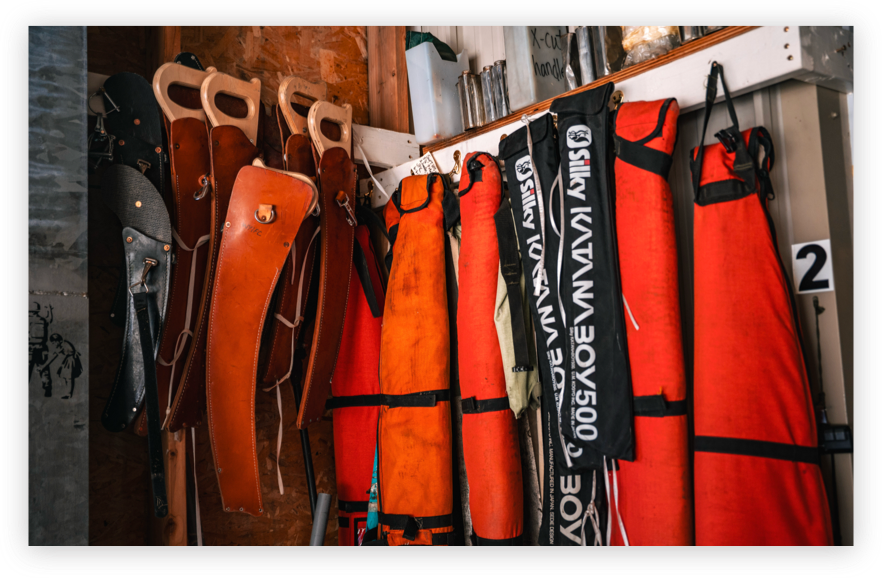
The smokejumper crew's saws stored in their leather or canvas sheaths. PHOTO BY TAYLOR OWENS
“We typically work long days on fires, and it’s not unusual to get back to camp after dark, eat something, and head to bed,” Leahy said. “You get up and do it again the next day.”
Some seasons become legendary because of the fires. Others become memorable because of the places you went. But a lot of the time, years later, what smokejumpers remember most is simply the crew they were there with.
Early in August, Leahy got a call to a fire on the Shoshone National Forest, just east of Yellowstone—a small burn, only about two and a half acres, on top of a ridge. Wind made it too dangerous to jump directly onto the ridge, so the crew jumped into a meadow roughly a thousand feet below in the valley while their cargo dropped separately near the fire itself. They landed, hiked up, retrieved their gear, and got to work. With two helicopters assisting, they stopped the fire’s forward progress that night, then spent several more days chasing down hot spots to make sure it stayed out.
There was a detail to that call that stuck with Leahy. Before becoming a jumper, he had worked on the Shoshone National Forest crew alongside another firefighter who ended up on that same fire crew—and the person who ordered them both out to it was the boss who’d helped them get into smokejumping in the first place. “It was a full-circle moment for both of us,” he said. “The views were stunning, the firefighting was great, and the company was second to none.”
Being first on the group offers a unique perspective; while Leahy has only been jumping since 2021, even in that short span of time, he’s noticed something—fire seasons don’t behave the way they used to.
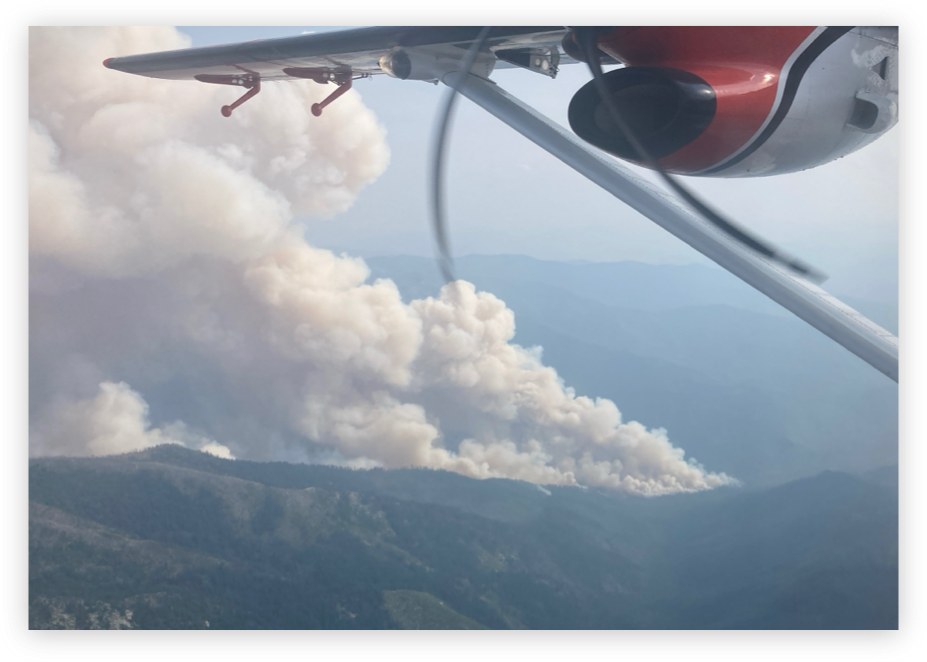
Wildland fire smokejumper plane. Photo courtesy of Forest Service Northern Region
Historically, the Northern Rockies have leaned toward a later fire season. But longer periods of dry, warm weather have been stretching that window on both ends.
“Some years things can start earlier, stay busy later, or remain unpredictable for longer,” Leahy said. Every season develops its own personality, he added—some are relentless from the first lightning strike, others leave crews waiting weeks for anything to ignite. When West Yellowstone is quiet, jumpers get sent to bases that are busy elsewhere in the country; when it’s not, jumpers from other regions come to them. It’s one of the advantages of a program that isn’t tied to a single patch of ground.
That flexibility matters more, Leahy said, because the fire environment itself has grown harder to predict. “You can look at a chunk of ground and think you understand it, and then terrain, fuel conditions, or weather can completely change the situation,” he said.
His perspective on fire is shaped as much by ecology as by firefighting. Leahy studied ecology and conservation at Montana State before joining the program and that background he said, changed how he sees fire’s role in a landscape like Yellowstone.
“Fire isn’t simply something that’s good or bad,” Leahy said. “It’s been a part of these ecosystems for a very long time, and many of them have evolved with it.” At the same time, the modern landscape includes communities, roads, and infrastructure that fire didn’t have to contend with a century ago, which means there are real reasons to put some fires out, even as others are left to play their natural role.
“I think the bigger challenge going forward will be figuring out how we live with fire,” Leahy said, “allowing fire to continue playing the ecological role it has always played while also doing what we can to mitigate its impacts on the communities and resources that are important to us.”
Smokejumpers, with their ability to reach fires early and in terrain inaccessible by engine or hand crew, are one small piece of managing that balance. Leahy is careful not to overstate his own vantage point—he hasn’t yet seen the decades of change that older jumpers talk about—but he shares their observations.
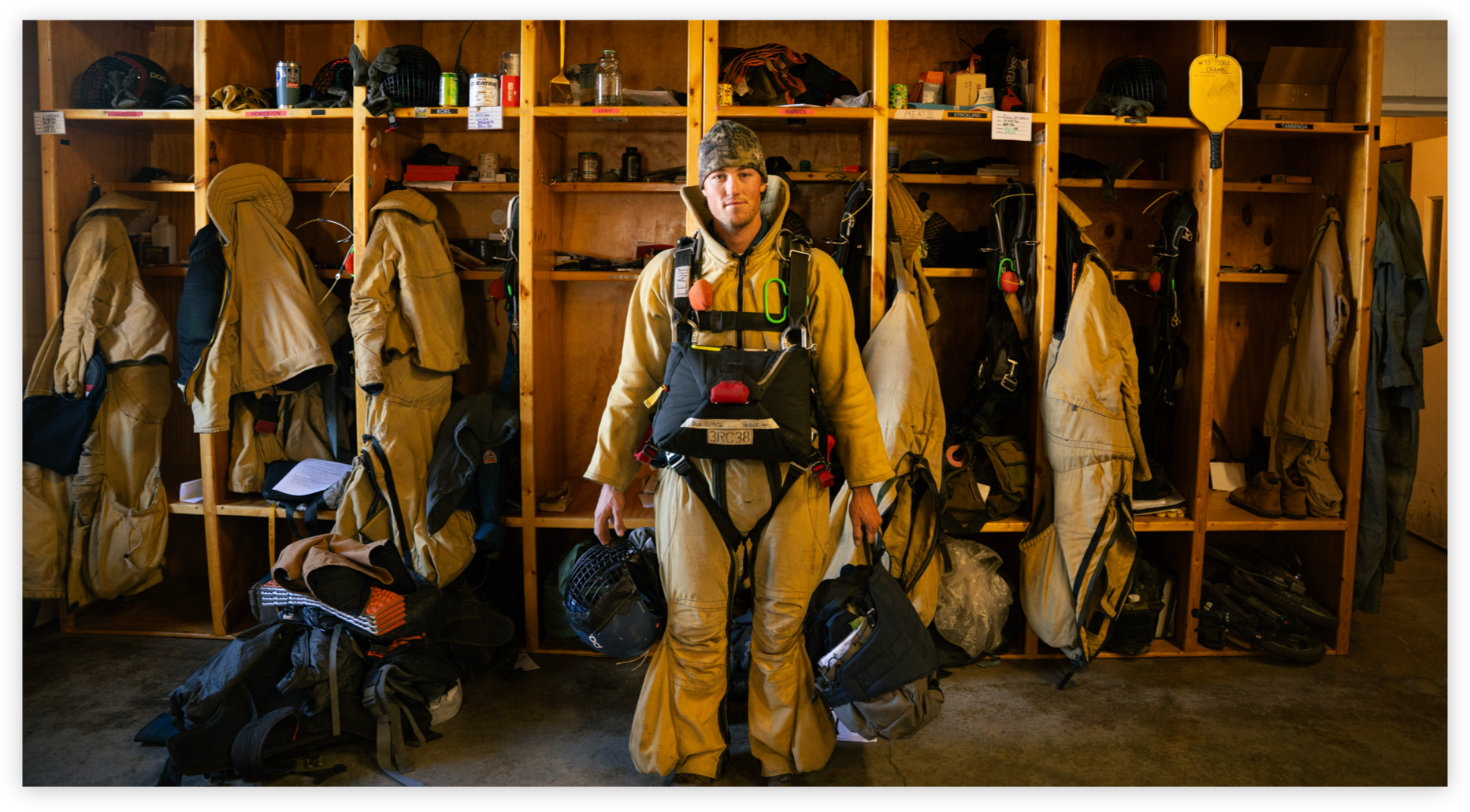
Smokejumper Nathaniel Leahy poses in full gear in front of the crew's personal storage. PHOTO BY TAYLOR OWENS
“There is a broad recognition throughout the fire community that conditions are changing,” he said, “and that fire seasons in many places are becoming more complex, longer, and less predictable.”
When asked what actually sticks with him, Leahy said individual fires themselves rarely come up first.
Because smokejumpers move between bases and get sent wherever they’re needed most, it’s entirely normal to end up with people you’ve never worked with before.
“You can get on a plane somewhere you’ve never been before with seven people you’ve never met, and you still have a tremendous amount of trust in those jumpers,” Leahy said. Whether they’re a rookie or a twenty-year veteran, every jumper has gone through the same selection-based process and met the same operational standards. On the ground, the first person out the door becomes the JIC, regardless of experience level, and the crew operates with the same capability either way.
“Everyone has to be able to look at the problem in front of them, understand the overall objective, and figure out where they can be useful,” Leahy said. Once boots hit the ground, there’s rarely anyone standing over a jumper’s shoulder telling them exactly what to do. That independence only works because of trust.
It adds up fast. Over a season, jumpers see each other exhausted, cold, frustrated, and also at their best. “That’s a bond that’s hard to replicate anywhere else,” Leahy said.
By winter, that crew scatters back to families, partners, and lives spread across the country, back to being hunters, ski patrollers, nurses, EMTs, farmers, and dads. But by spring, Leahy said, people start missing the work and the people just as much. The unknown is one of his favorite parts of the job, never quite knowing whether a call will take him to a remote corner of Alaska, the Great Basin, or straight back into the Yellowstone backcountry.
“The fires eventually blur together. The places will too,” Leahy said. “But I’ll remember the people.”
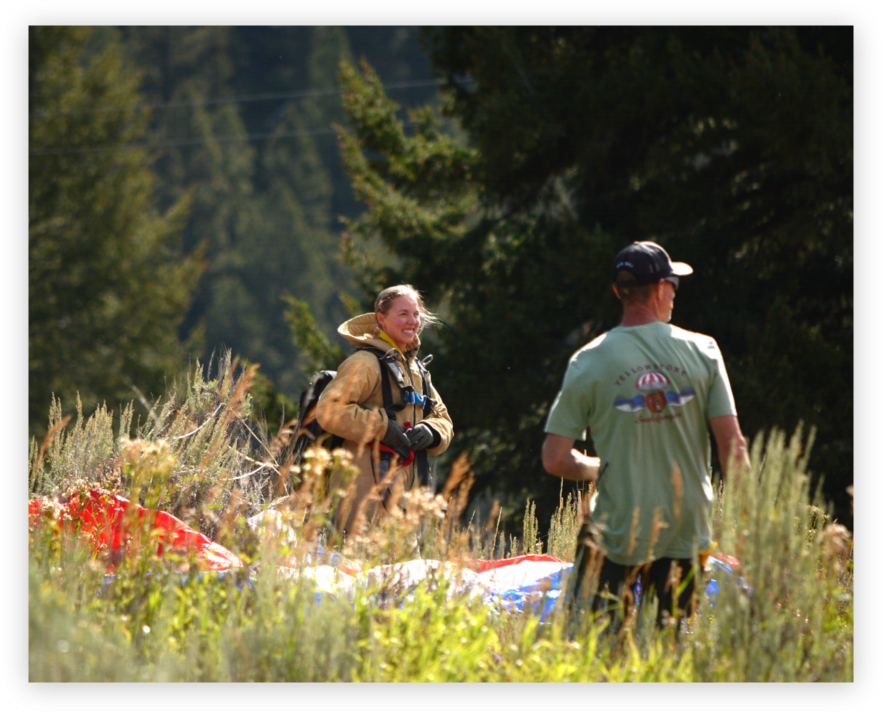
Ground crew member JP Knapp greets smokejumper Valerie Gill shortly after Valerie’s landing at Refuge Point. Photo courtesy of Forest Service Northern Region