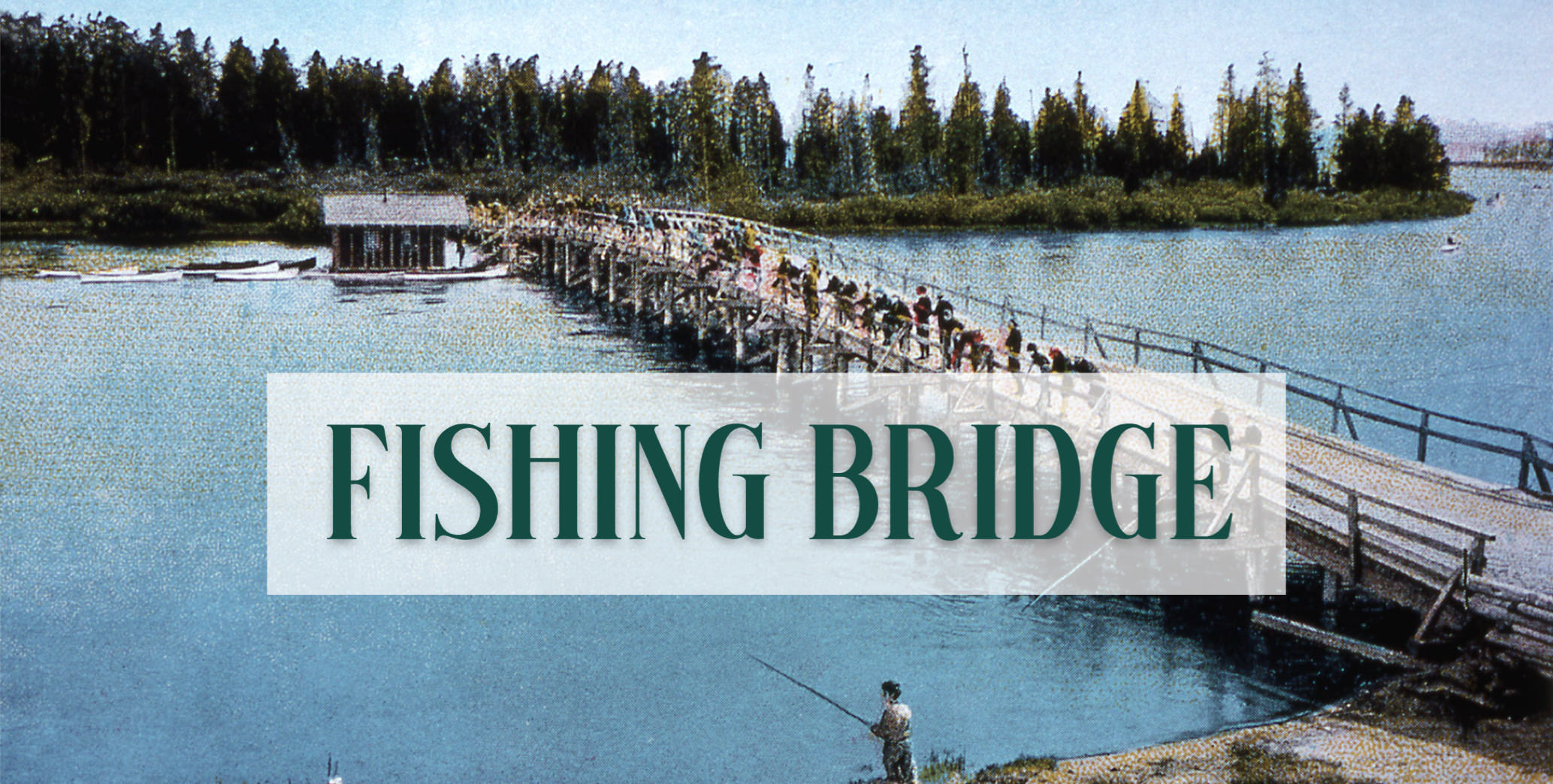
People fishing at Fishing Bridge. Photo by Frank J. Haynes

By Taylor Owens
A Lesson in Yellowstone’s Evolution
On Yellowstone’s southeastern side, near where the Yellowstone River flows out of Yellowstone Lake, stands a structure known as Fishing Bridge—a place where fishing is no longer allowed. Today, visitors lean against the wooden railing, feeling the steady wind off the lake and watching fish move through the water below, rather than catching them.
But it wasn’t always this way. There was a time when anglers lined the bridge shoulder to shoulder, casting their lines into the river and pulling trout from the current throughout the day. The fishing poles are gone, but the bridge remains. And in many ways, Fishing Bridge tells the story of Yellowstone itself—how the world’s first national park evolved from a place visitors were encouraged to use to one carefully managed for protection.
But it wasn’t always this way. There was a time when anglers lined the bridge shoulder to shoulder, casting their lines into the river and pulling trout from the current throughout the day. The fishing poles are gone, but the bridge remains. And in many ways, Fishing Bridge tells the story of Yellowstone itself—how the world’s first national park evolved from a place visitors were encouraged to use to one carefully managed for protection.
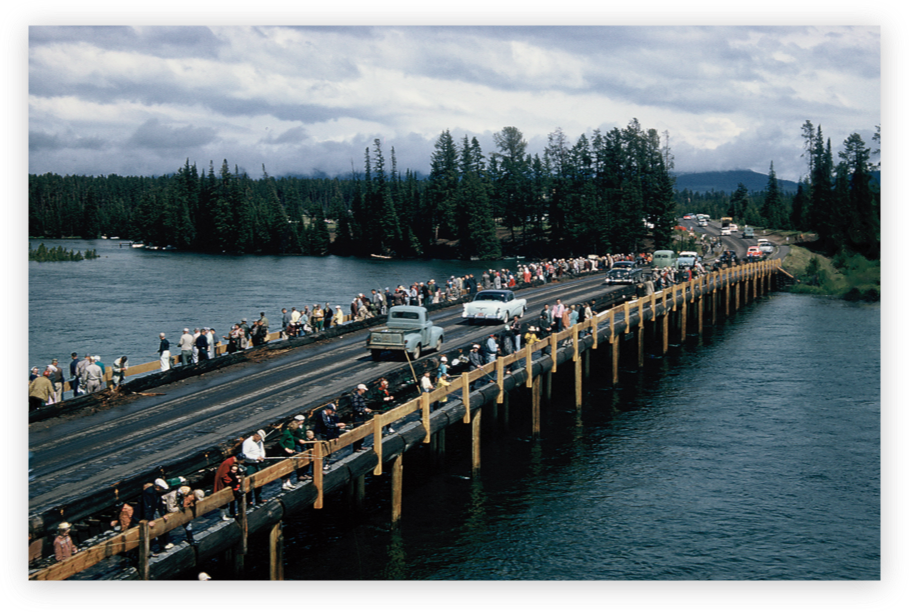
Fishing Bridge, Yellowstone, 1956. Photo by Walter Reed
When Yellowstone National Park was established in 1872, it became the first national park in the world. But the people responsible for managing it had little precedent to follow. As Alicia Murphy, Yellowstone National Park historian, explained, “We didn’t know how to manage a national park—we didn’t have national parks. We were kind of learning as we go.”
In those early decades, the park was often managed in ways that today might seem surprising. “Early on we were a lot more consumptive with the park,” Murphy said. “We were a lot more interested in managing it in a very kind of domestic way.”
In those early decades, the park was often managed in ways that today might seem surprising. “Early on we were a lot more consumptive with the park,” Murphy said. “We were a lot more interested in managing it in a very kind of domestic way.”
Yellowstone sometimes resembled a carefully tended landscape rather than a protected wilderness. Wildlife were fed, predators were removed to protect other species, and hay fields were even maintained in parts of the park.
Fish management reflected the same philosophy. “We had a fish hatchery where we raised millions of fish and released them into the park,” Murphy explained, part of an effort to shape the park’s wildlife rather than allow natural systems to operate on their own.
One place where that approach played out clearly was at the outlet of Yellowstone Lake, where the river flows beneath Fishing Bridge. The location is a spawning run for native Yellowstone cutthroat trout, drawing large numbers of fish each year and making it an irresistible place for anglers.
Fishing Bridge was originally built for transportation, not fishing. In the early days of tourism in Yellowstone National Park, most visitors traveled the park along the Grand Loop Road, a route designed to take stagecoach passengers past the park’s major sights.
As travel to the region expanded, communities outside the park sought connections to that route. When the town of Cody, Wyoming was established east of the park, local leaders wanted access for visitors entering Yellowstone from that direction. The road from the East Entrance eventually reached the outlet of Yellowstone Lake, but one final piece was needed. “That road from the East Entrance to the outlet of Yellowstone Lake… was really completed with what we now call Fishing Bridge,” Murphy said, connecting Cody to the park’s main road system.
The bridge quickly became more than just a transportation link. It also crossed one of the most productive fishing spots in the park, where spawning Yellowstone cutthroat trout gathered in large numbers. “Fishing was extremely popular,” Murphy explained. “We have many photos of hundreds of people lining the bridge fishing.” The sight of so many trout in the clear water below drew many anglers.
For some families, fishing at the bridge became an all-day affair. “People didn’t have real limits,” Murphy said. “I’ve talked to people who recall their childhood—the kids would fish all day and the moms would be back at camp canning the fish.” Just downstream, a campground near the bridge provided a place for visitors to stay while they fished and processed their catch. Visitors pulled dozens of trout from the river, often preserving them to take home and feed their families long after their Yellowstone trip had ended.
Over time, the popularity of fishing at the bridge began to reveal a problem. Large numbers of trout gather beneath the bridge during spawning season, making the fish especially vulnerable.
Fish management reflected the same philosophy. “We had a fish hatchery where we raised millions of fish and released them into the park,” Murphy explained, part of an effort to shape the park’s wildlife rather than allow natural systems to operate on their own.
One place where that approach played out clearly was at the outlet of Yellowstone Lake, where the river flows beneath Fishing Bridge. The location is a spawning run for native Yellowstone cutthroat trout, drawing large numbers of fish each year and making it an irresistible place for anglers.
Fishing Bridge was originally built for transportation, not fishing. In the early days of tourism in Yellowstone National Park, most visitors traveled the park along the Grand Loop Road, a route designed to take stagecoach passengers past the park’s major sights.
As travel to the region expanded, communities outside the park sought connections to that route. When the town of Cody, Wyoming was established east of the park, local leaders wanted access for visitors entering Yellowstone from that direction. The road from the East Entrance eventually reached the outlet of Yellowstone Lake, but one final piece was needed. “That road from the East Entrance to the outlet of Yellowstone Lake… was really completed with what we now call Fishing Bridge,” Murphy said, connecting Cody to the park’s main road system.
The bridge quickly became more than just a transportation link. It also crossed one of the most productive fishing spots in the park, where spawning Yellowstone cutthroat trout gathered in large numbers. “Fishing was extremely popular,” Murphy explained. “We have many photos of hundreds of people lining the bridge fishing.” The sight of so many trout in the clear water below drew many anglers.
For some families, fishing at the bridge became an all-day affair. “People didn’t have real limits,” Murphy said. “I’ve talked to people who recall their childhood—the kids would fish all day and the moms would be back at camp canning the fish.” Just downstream, a campground near the bridge provided a place for visitors to stay while they fished and processed their catch. Visitors pulled dozens of trout from the river, often preserving them to take home and feed their families long after their Yellowstone trip had ended.
Over time, the popularity of fishing at the bridge began to reveal a problem. Large numbers of trout gather beneath the bridge during spawning season, making the fish especially vulnerable.
“We quickly realized that was actually having an impact on the greater population of Yellowstone cutthroat trout,” Murphy explained. The trout are not only an iconic native species in Yellowstone National Park, they are also an important food source. “It’s an important one for grizzly bears,” Murphy said, noting that the spawning streams around the lake are prime bear habitat.
At the same time, Yellowstone itself was changing. In the decades after World War II, visitation to the park grew dramatically. “When the park was established, we would have less than a million visitors a year,” Murphy said. As more people arrived, the cumulative impact on the park’s resources became harder to ignore.
At the same time, Yellowstone itself was changing. In the decades after World War II, visitation to the park grew dramatically. “When the park was established, we would have less than a million visitors a year,” Murphy said. As more people arrived, the cumulative impact on the park’s resources became harder to ignore.
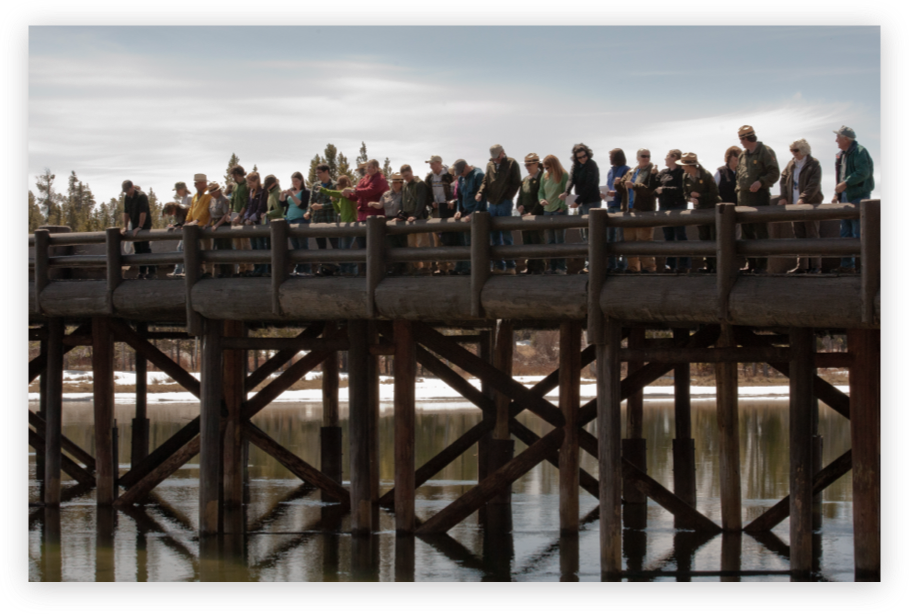
Visitors on Fishing Bridge. Seasonal interp rangers in training at Fishing Bridge. Photo by Jay Elhard
Scientific understanding was also evolving. Fields like fisheries science and wildlife biology were beginning to shape how parks were managed. “As science itself evolved, so did concepts like an ecosystem and a landscape, and how species are interconnected,” Murphy said.
This led park managers to rethink earlier practices. Instead of trying to control every aspect of Yellowstone’s wildlife, the philosophy gradually shifted toward protecting natural processes.
That shift eventually reached Fishing Bridge. By the 1970s, fishing from the bridge was prohibited in order to protect spawning cutthroat trout. Visitors can still walk across Fishing Bridge today, leaning over the railing to watch fish move through the clear current below—but the fishing lines are gone.
“You are still encouraged to walk across Fishing Bridge, and you can stop and view the fish that are down there,” Murphy said. While watching the trout remains a popular activity, the scene looks very different than it once did. “You don’t generally see hundreds of people outlining the bridge anymore like they did when fishing was allowed.”
The bridge itself still serves as an important crossing in Yellowstone National Park. Located near the outlet of Yellowstone Lake, it remains a gateway for visitors entering from the east.
Fishing Bridge tells a larger story about Yellowstone’s evolution. In the park’s early years, managers had little precedent or scientific understanding to guide them. Over time, new research reshaped that approach, shifting the focus from using Yellowstone’s resources to protecting the ecosystems that sustain them.
“You know, Yellowstone is an evolution,” Murphy explained. “We are evolving our understanding of how to maintain this landscape and this ecosystem.”
Standing on the bridge today, visitors witness that change firsthand. “They are standing on a physical representation of the park’s evolution,” Murphy said—an enduring reminder of Yellowstone’s ongoing effort to balance access with stewardship.
This led park managers to rethink earlier practices. Instead of trying to control every aspect of Yellowstone’s wildlife, the philosophy gradually shifted toward protecting natural processes.
That shift eventually reached Fishing Bridge. By the 1970s, fishing from the bridge was prohibited in order to protect spawning cutthroat trout. Visitors can still walk across Fishing Bridge today, leaning over the railing to watch fish move through the clear current below—but the fishing lines are gone.
“You are still encouraged to walk across Fishing Bridge, and you can stop and view the fish that are down there,” Murphy said. While watching the trout remains a popular activity, the scene looks very different than it once did. “You don’t generally see hundreds of people outlining the bridge anymore like they did when fishing was allowed.”
The bridge itself still serves as an important crossing in Yellowstone National Park. Located near the outlet of Yellowstone Lake, it remains a gateway for visitors entering from the east.
Fishing Bridge tells a larger story about Yellowstone’s evolution. In the park’s early years, managers had little precedent or scientific understanding to guide them. Over time, new research reshaped that approach, shifting the focus from using Yellowstone’s resources to protecting the ecosystems that sustain them.
“You know, Yellowstone is an evolution,” Murphy explained. “We are evolving our understanding of how to maintain this landscape and this ecosystem.”
Standing on the bridge today, visitors witness that change firsthand. “They are standing on a physical representation of the park’s evolution,” Murphy said—an enduring reminder of Yellowstone’s ongoing effort to balance access with stewardship.