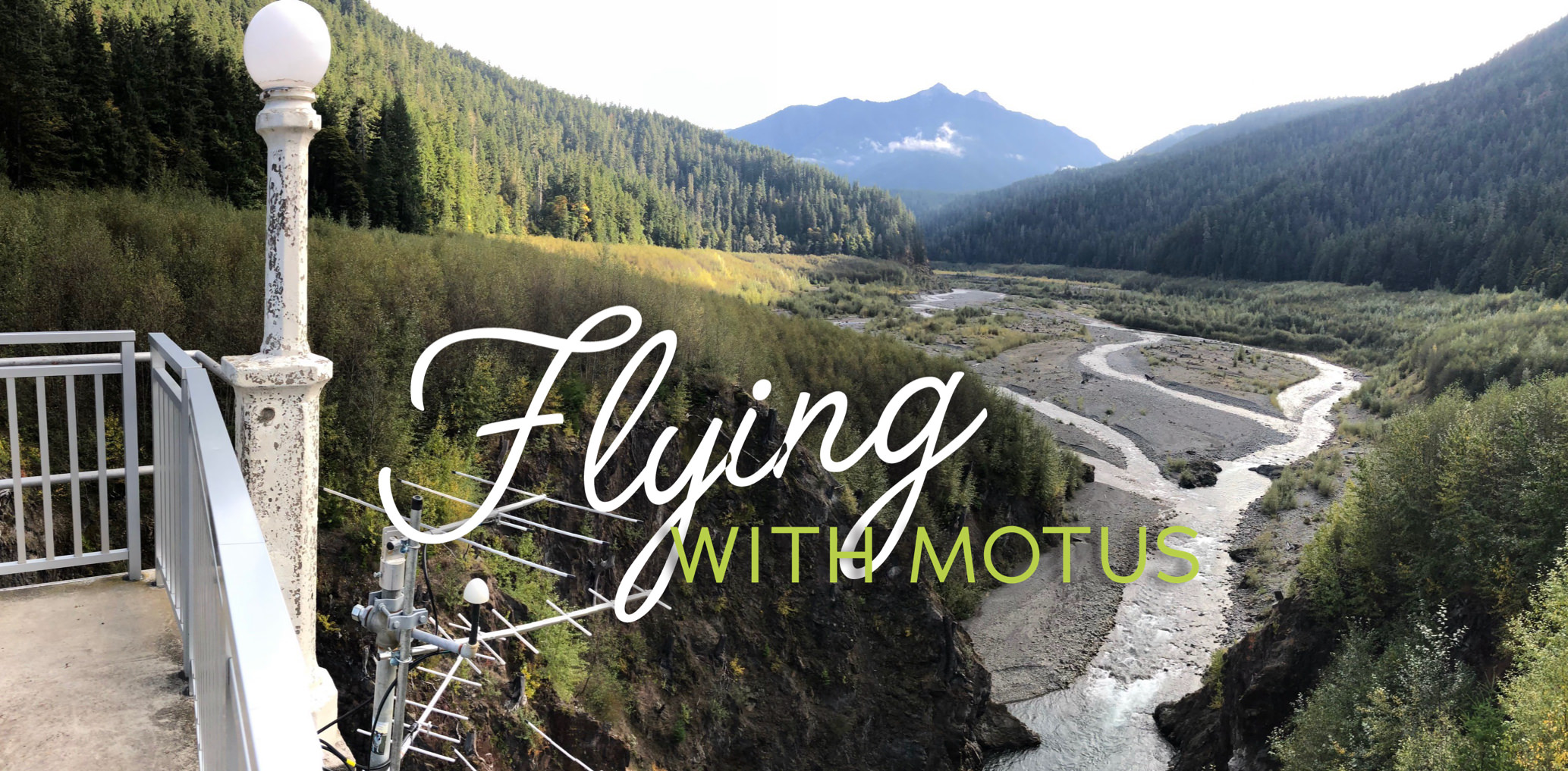
A Motus tower installed on the spillway of the former Glines Canyon Dam in Olympic National Park. The solar-powered array of radio antennae will detect the signals send by tiny transmitters known as “nanotags” that have been attached to small flying animals. This tower was installed to study bat movement behavior. | Photo By Michael Hansen, USGS

By Leath Tonino
Picture an old-school TV antenna, not rabbit ears protruding from the television in the den, but a silvery, fingery, towery gizmo standing proud of the house’s ridge cap. Multiply that picture by 2,377 and scatter these antennas all around the planet, from Chile to Canada to Australia to Jamaica to Norway to Mexico. Be sure to install some in the Greater Yellowstone Ecosystem, at Red Rock Lakes National Wildlife Refuge in Montana and Gray’s Lake National Wildlife Refuge in Idaho. For good measure, erect a couple on the outskirts of Pinedale, Wyoming, too.
Now kick off your boots, crack a beer, and wait.
This is Motus, the name for both a sprawling network of automated radio telemetry stations and a global research community studying the movement and behavior — particularly the spatio-temporal migratory patterns — of hundreds of different bird species (also bats and chunky insects). Though the tech is advanced and the outpouring of data is overwhelming, the methodology is simple and easy to grasp. Biologists trap a critter, affix to its back a tiny tag that emits a unique identifying signal, then release it to the skies. Henceforth, when that individual — say, a Northern Saw-whet Owl labeled #60283 — flies within 15 or 20 kilometers of a Motus station, its presence will get registered in real time. To date, 61,928 animals have been tagged.
This is Motus, the name for both a sprawling network of automated radio telemetry stations and a global research community studying the movement and behavior — particularly the spatio-temporal migratory patterns — of hundreds of different bird species (also bats and chunky insects). Though the tech is advanced and the outpouring of data is overwhelming, the methodology is simple and easy to grasp. Biologists trap a critter, affix to its back a tiny tag that emits a unique identifying signal, then release it to the skies. Henceforth, when that individual — say, a Northern Saw-whet Owl labeled #60283 — flies within 15 or 20 kilometers of a Motus station, its presence will get registered in real time. To date, 61,928 animals have been tagged.
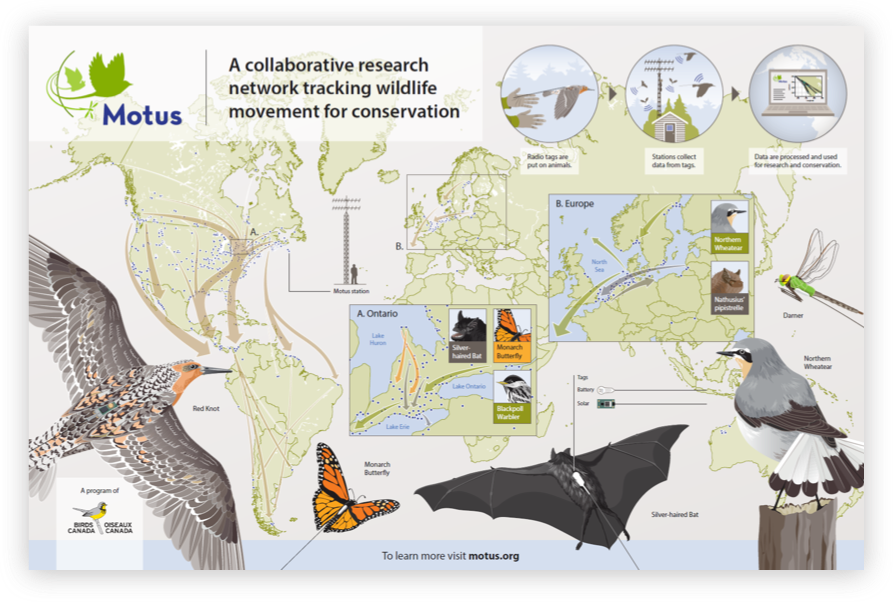
Motus Infograph | Graphic By Motus/Birds Canada
Did you know that a Sandhill Crane just moments ago passed overhead, cruising among the clouds? And that it was hot on the heels, er, metatarsals of a White Pelican? And that last night, under cover of darkness, a slew of warblers, thrushes, and vireos flapped through the neighborhood? Motus renders the invisible busyness, the hidden-in-plain-sight flow of the world, suddenly and shockingly perceivable — at least on a laptop screen. It’s magic of a sort.
Thanks to a friendly field ecologist’s recommendation (This is very cool stuff, definitely worth checking out), I’ve become nerdily obsessed with the Motus website’s cornucopia of maps and flightpaths, stories and surprises. Specifically, I’ve become obsessed with tracking the continent-spanning journeys of, well, #60283 is a perfect example. This diminutive owl—Northern Saw-whets weigh between 2 and 5 ounces—was first detected at Red Rocks Lake NWR on October 29, 2024. Presumably, it wintered in the region, hunting rodents in the conifer forests of the Centennial Mountains, before winging north for the summer on March 27, 2025. Then… radio silence. Six months later, on October 2, 2025, #60283 finally reemerged west of Dawson Creek, British Columbia, a whopping 1,000-plus kilometers from its previous confirmed waypoint.
Here’s another example—#65463, a drab, sparrow-sized grassland species called a Sprague’s Pipit. It showed up at Red Rocks Lake NWR on August 19, 2025 and at Lacreek NWR in South Dakota on October 28, 2025. What happened in the interim? Maybe it spent early fall in Yellowstone National Park, where there currently are no Motus stations? This much is certain: Lacreek was at best a brief rest stop. Eleven hours and 900 kilometers after pinging that antenna, #65463 arrived at Sandy Sanders Wildlife Management Area on the Oklahoma-Texas border.
Thanks to a friendly field ecologist’s recommendation (This is very cool stuff, definitely worth checking out), I’ve become nerdily obsessed with the Motus website’s cornucopia of maps and flightpaths, stories and surprises. Specifically, I’ve become obsessed with tracking the continent-spanning journeys of, well, #60283 is a perfect example. This diminutive owl—Northern Saw-whets weigh between 2 and 5 ounces—was first detected at Red Rocks Lake NWR on October 29, 2024. Presumably, it wintered in the region, hunting rodents in the conifer forests of the Centennial Mountains, before winging north for the summer on March 27, 2025. Then… radio silence. Six months later, on October 2, 2025, #60283 finally reemerged west of Dawson Creek, British Columbia, a whopping 1,000-plus kilometers from its previous confirmed waypoint.
Here’s another example—#65463, a drab, sparrow-sized grassland species called a Sprague’s Pipit. It showed up at Red Rocks Lake NWR on August 19, 2025 and at Lacreek NWR in South Dakota on October 28, 2025. What happened in the interim? Maybe it spent early fall in Yellowstone National Park, where there currently are no Motus stations? This much is certain: Lacreek was at best a brief rest stop. Eleven hours and 900 kilometers after pinging that antenna, #65463 arrived at Sandy Sanders Wildlife Management Area on the Oklahoma-Texas border.
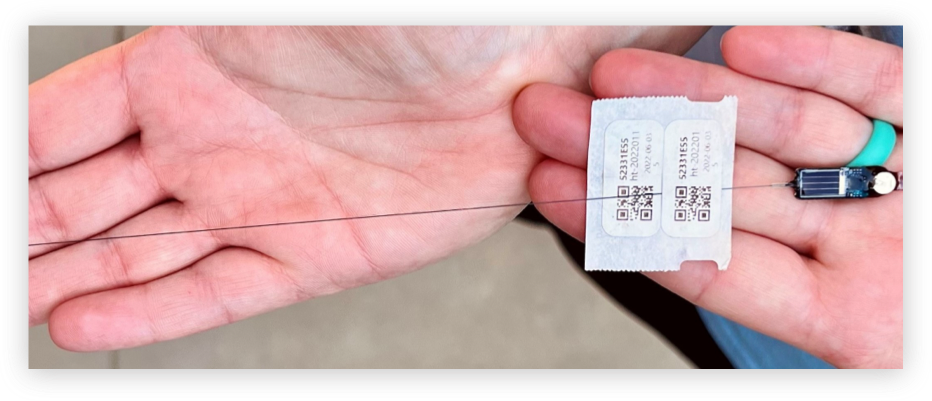
Motus Tag | Photo By Rosalie Wetzel/USFWS
That these avian narratives are simultaneously down-to-the-second detailed and vague in the extreme is part of their allure. Hemingway believed omission was the key to spinning a compelling yarn, as it invites readers to fill in the gaps and engage. Indeed, as with an engrossing novel or movie, Motus leaves a lot to the imagination, and hunching over my laptop, clicking and squinting and clicking, I inevitably wonder: Is #60283 faring okay? Is that tough little owl planning to return to Red Rock Lakes again soon? Is it going to bump into #65463, the pipit? Is it going to appear in a new unexpected spot? This is high-level drama, a geographical adventure featuring an all-star cast of characters, a mystery that keeps me tuning in.
But entertainment is merely one of the benefits of snagging rides on Motus birds, vicariously traveling to and from (and to and from, and to and from) the Greater Yellowstone Ecosystem. Better yet is the realization — a realization that feels increasingly important in an era of fragmented habitats and busted biomes — that nearby places are made of distant places, that the local and the far-flung are ultimately of a piece, that as the scientists and poets and mystics have insisted for ages, nature is a tapestry, a lattice, a gossamer tissue, a sensitive web, a trembling whole. John Muir once wrote, “When we try to pick out anything by itself, we find it hitched to everything else in the Universe.” Or to borrow an image from the Buddhist philosophy of interconnection and interdependence: Envision a vast net with a jewel situated at each node, the polished surface of which reflects every other jewel. Got that in your mind’s eye? Excellent. Now substitute old-school TV antennas for jewels, kick off your boots, crack a beer….
Yesterday, during a Motus binge, it hit me with the force of epiphany: Homo sapiens flying from Paris to Bozeman and Tokyo to Jackson Hole, driving rental cars to Old Faithful and Mammoth Hot Springs, vacationing for a while and then moseying on — we too are a species in perpetual motion, drawn to Yellowstone National Park by the richness of the land, the awesomeness of the earth. Granted, us featherless humans don’t carry Motus tags. We do, however, carry smartphones equipped with GPS.
Perhaps somebody could develop an app to help visitors visualize their place within the place within the place within the place?
That’s a map, a story, I’d love to see.
Yesterday, during a Motus binge, it hit me with the force of epiphany: Homo sapiens flying from Paris to Bozeman and Tokyo to Jackson Hole, driving rental cars to Old Faithful and Mammoth Hot Springs, vacationing for a while and then moseying on — we too are a species in perpetual motion, drawn to Yellowstone National Park by the richness of the land, the awesomeness of the earth. Granted, us featherless humans don’t carry Motus tags. We do, however, carry smartphones equipped with GPS.
Perhaps somebody could develop an app to help visitors visualize their place within the place within the place within the place?
That’s a map, a story, I’d love to see.