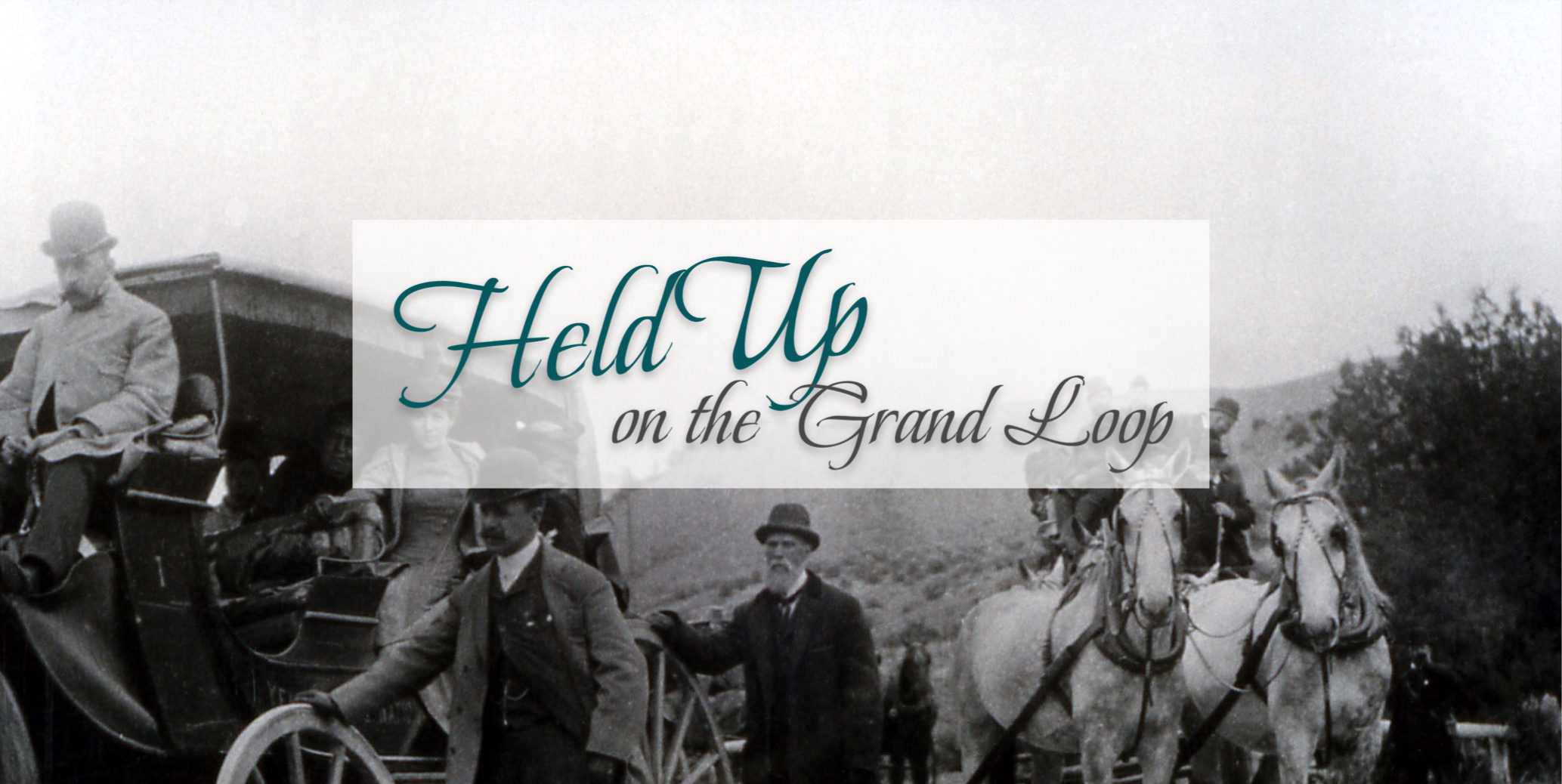
Tourists in stagecoaches. Photo courtesy of Yellowstone’s Photo Collection

By Taylor Owens
Stagecoach Robberies in Yellowstone’s Early Tourist Era
Long before paved roads and pullouts, Yellowstone visitors toured the park in stage lines — dusty, rattling caravans moving through wilderness with no quick way to call for help. Between 1887 and 1915, a string of holdups punctured that adventure with a darker edge: the stagecoach robbery.
Imagine: it’s the summer of 1908, and you’re five days into a stagecoach tour of Yellowstone National Park. You’re riding in an observation wagon, watching the landscape pass like a moving panorama, with thermal pools flashing between trees and pockets of water where ruddy ducks swim. Your wagon is the third in a line of fifteen, heading south along the Grand Loop.
Aside from the other passengers around you, you are effectively alone.
There are no cellphones. No reliable telephone service. The nearest park station is hours away. Automobiles haven’t arrived yet. The road beneath you isn’t smooth pavement — it’s dirt, carved by ruts and holes that shake wheels loose and throw dust into the air. Early Yellowstone travel wasn’t just scenic. It was vulnerable. And while modern visitors might joke about bears, in this era there was more than one thing worth worrying about.
Between 1887, 1897, 1908, 1914, and 1915, tourists and stagecoach drivers in Yellowstone faced the iconic Western crime: the stagecoach holdup. These weren’t constant occurrences, but when they happened, they hit the park hard because they disrupted the very thing Yellowstone was beginning to sell: a grand wilderness made accessible, safe enough to tour on schedule.
The most audacious of these crimes occurred on August 24, 1908. Near Kepler Cascades, a lone masked bandit stopped seventeen stagecoaches carrying roughly 170 passengers. Moving deliberately from wagon to wagon, the robber collected cash, jewelry, and personal valuables while tourists waited in stunned silence. Despite eyewitness descriptions and an extensive search, the robber disappeared into the surrounding wilderness. The case was never solved, and served as a reminder that Yellowstone’s vastness could still swallow a man whole.
Six years later came the park’s most documented robbery.
Imagine: it’s the summer of 1908, and you’re five days into a stagecoach tour of Yellowstone National Park. You’re riding in an observation wagon, watching the landscape pass like a moving panorama, with thermal pools flashing between trees and pockets of water where ruddy ducks swim. Your wagon is the third in a line of fifteen, heading south along the Grand Loop.
Aside from the other passengers around you, you are effectively alone.
There are no cellphones. No reliable telephone service. The nearest park station is hours away. Automobiles haven’t arrived yet. The road beneath you isn’t smooth pavement — it’s dirt, carved by ruts and holes that shake wheels loose and throw dust into the air. Early Yellowstone travel wasn’t just scenic. It was vulnerable. And while modern visitors might joke about bears, in this era there was more than one thing worth worrying about.
Between 1887, 1897, 1908, 1914, and 1915, tourists and stagecoach drivers in Yellowstone faced the iconic Western crime: the stagecoach holdup. These weren’t constant occurrences, but when they happened, they hit the park hard because they disrupted the very thing Yellowstone was beginning to sell: a grand wilderness made accessible, safe enough to tour on schedule.
The most audacious of these crimes occurred on August 24, 1908. Near Kepler Cascades, a lone masked bandit stopped seventeen stagecoaches carrying roughly 170 passengers. Moving deliberately from wagon to wagon, the robber collected cash, jewelry, and personal valuables while tourists waited in stunned silence. Despite eyewitness descriptions and an extensive search, the robber disappeared into the surrounding wilderness. The case was never solved, and served as a reminder that Yellowstone’s vastness could still swallow a man whole.
Six years later came the park’s most documented robbery.
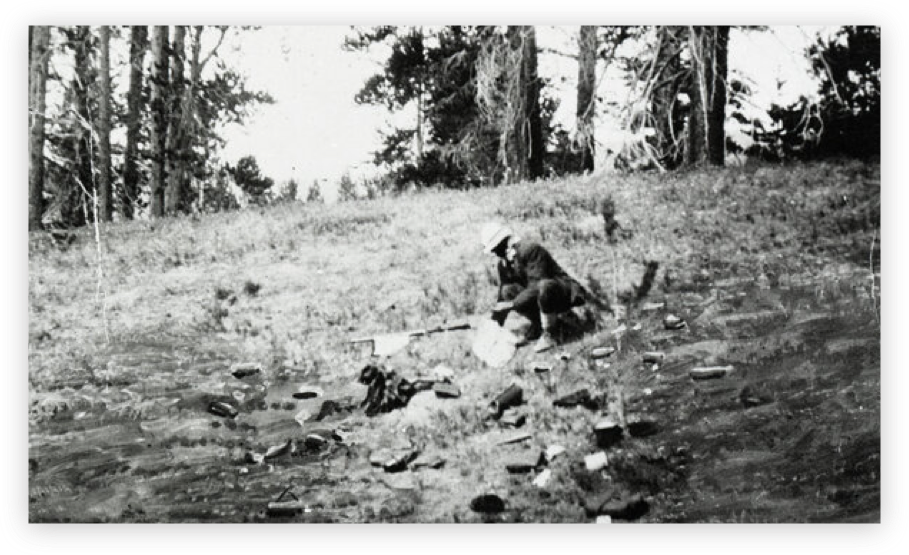
View of man (Ed Trafton) rummaging through items from a stagecoach robbery. Photo courtesy of Yellowstone National Park Heritage and Research Center
On July 29, 1914, near Shoshone Point due east of Old Faithful, gunmen stopped twenty-five stagecoaches carrying more than 165 passengers and made off with nearly $1,000 in cash and jewelry. Unlike earlier incidents, this holdup unfolded in full view of a massive tour convoy, magnifying its impact and urgency.
In the middle of the chaos, one tourist did something extraordinary. W. I. Allinder managed to secretly photograph one of the robbers during the holdup. In a moment when most people were keeping their hands visible and their eyes down, Allinder captured evidence. The image, part souvenir, part proof, would become one of the most unusual artifacts in Yellowstone’s outlaw history.
In the middle of the chaos, one tourist did something extraordinary. W. I. Allinder managed to secretly photograph one of the robbers during the holdup. In a moment when most people were keeping their hands visible and their eyes down, Allinder captured evidence. The image, part souvenir, part proof, would become one of the most unusual artifacts in Yellowstone’s outlaw history.
The robbery didn’t end with the holdup itself. Archival correspondence and law enforcement records detail what happened next: immediate panic, swift communication between park hubs, and a manhunt shaped by the logistical reality of the park. During the robbery, one stagecoach managed to turn around unnoticed and race back west toward Old Faithful to call for help. In an era with limited infrastructure, that retreat mattered. It was, effectively, Yellowstone’s emergency response system in motion.
Investigators circulated an official description of the robber:
“About 5’8”, weighing about 145 lbs. Blue eyes, short hair, probably dark, with large sunburnt hands. He carried a Winchester rifle and used a black handkerchief as a mask. Dressed in tan corduroy trousers tucked into black, high laced boots, with thick grey socks visible. He wore a felt hat with a hole in it, and an old, faded coat. He spoke good English and was fairly polite.”
Investigators circulated an official description of the robber:
“About 5’8”, weighing about 145 lbs. Blue eyes, short hair, probably dark, with large sunburnt hands. He carried a Winchester rifle and used a black handkerchief as a mask. Dressed in tan corduroy trousers tucked into black, high laced boots, with thick grey socks visible. He wore a felt hat with a hole in it, and an old, faded coat. He spoke good English and was fairly polite.”
Then came the flood.
After the description went public, Yellowstone officials were inundated with tips and many were based on little more than intuition. Letters poured in naming “suspicious” men who wore thick socks. Or men with dark hair. Or newcomers with rumors attached. Some suggestions carried the confidence of certainty without the substance of proof. In the scramble to restore order and reassure the public, officials even arrested innocent men on hearsay alone.
Ultimately, the evidence held. The 1914 holdup led to the arrest and conviction of Edward B. Trafton, making it Yellowstone’s most traceable robbery case: a crime with a photograph, a paper trail, and a captured man at the end of it.
Yet not every Yellowstone stagecoach robbery left behind such clarity. Some survived only in memory — told years later, shaped by repetition, and polished into legend.
After the description went public, Yellowstone officials were inundated with tips and many were based on little more than intuition. Letters poured in naming “suspicious” men who wore thick socks. Or men with dark hair. Or newcomers with rumors attached. Some suggestions carried the confidence of certainty without the substance of proof. In the scramble to restore order and reassure the public, officials even arrested innocent men on hearsay alone.
Ultimately, the evidence held. The 1914 holdup led to the arrest and conviction of Edward B. Trafton, making it Yellowstone’s most traceable robbery case: a crime with a photograph, a paper trail, and a captured man at the end of it.
Yet not every Yellowstone stagecoach robbery left behind such clarity. Some survived only in memory — told years later, shaped by repetition, and polished into legend.
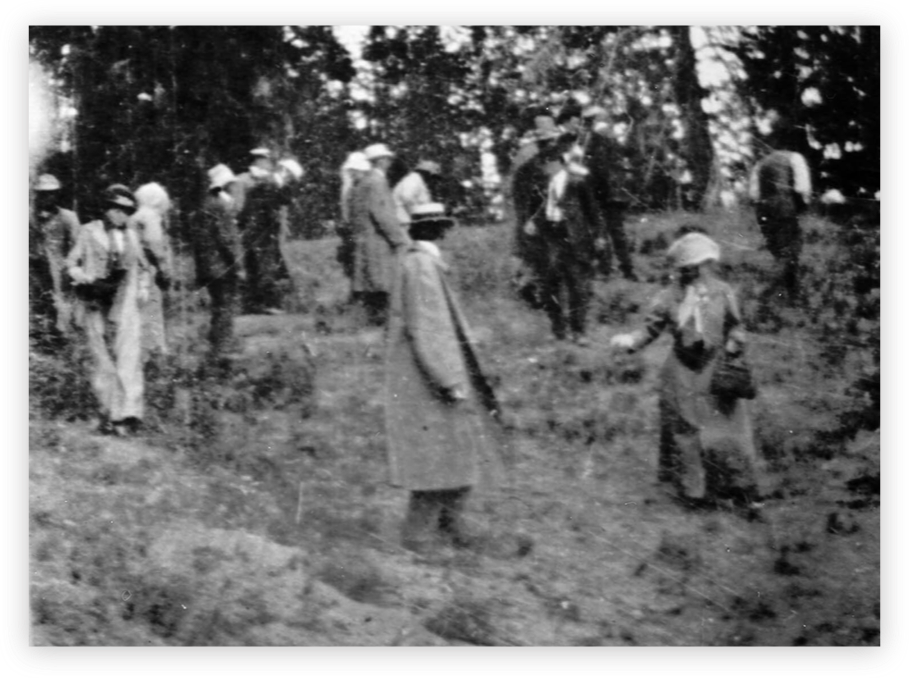
Stagecoach robbery victims looking for belongings.
Photo courtesy of Yellowstone National Park Museum Collection
Photo courtesy of Yellowstone National Park Museum Collection
One such story emerged decades after the stagecoach era had ended, preserved not in court records but in a file folder at the Pioneer Museum in Bozeman. In the 1950s, Jefferson Jones, longtime publisher of The Bozeman Daily Chronicle, quoted an interview with Lester Piersdorff, a Bozeman pioneer who claimed to have witnessed — and taken part in — a dramatic Yellowstone holdup in the 1880s.
According to Piersdorff, nine mounted road agents dressed in army uniforms stopped an army paymaster escort near Eagle’s Nest on the Gardner River. Only when the command “Hands up” was issued did the party realize the men were not a cavalry patrol. The robbers disarmed the soldiers, threw their weapons into the river, calmly transferred sacks of gold into regulation saddlebags — and then, Piersdorff said, saluted the officer before riding away toward Gardiner with $40,000 in gold.
It is a remarkable story. It is also almost certainly untrue.
Yellowstone historian Aubrey Haines later traced the account and concluded, “It is a beautiful little story, but there is no truth in it.” What survived, Haines suggested, was not a reliable eyewitness account but a legend — shaped by time, memory, and the desire to be close to a dramatic past.
That tension between record and recollection runs through Yellowstone’s stagecoach era. Some robberies, like the 1914 Shoshone Point holdup, are anchored by photographs, arrest records, and trial testimony. Others exist only as stories, resistant to verification but impossible to ignore. Together, they reveal a park still negotiating its identity: not yet fully governed, not entirely lawless, and never as controlled as its promoters hoped.
In total, park records confirm five stagecoach robberies during Yellowstone’s stagecoach era. Though rare, each carried outsized consequences. Newspapers seized on the stories. Tour companies worried about safety and reputation. Park officials faced mounting pressure to prove that Yellowstone was still orderly and not a frontier free-for-all.
That tension mattered. Yellowstone was in the midst of redefining itself, shifting from raw exploration to managed tourism. The robberies exposed the fragility of early infrastructure and the limits of authority in a landscape that still favored distance, silence, and concealment.
Stagecoaches themselves remain a defining piece of Yellowstone history. For years, they were the only way most visitors could see the park. Public use ended in 1916 when automobiles were allowed into Yellowstone, effectively closing the window that had made mass holdups possible. Faster communication, motorized patrols, and improved roads changed the balance.
Stagecoaches never fully disappeared. Today, they still operate in the park through tours departing from Roosevelt Lodge, connecting modern visitors to the era when the Grand Loop ran on hoofbeats and wheel spokes.
And that’s why the robbery stories endure. They aren’t just tales of crime. They’re snapshots of what early Yellowstone travel truly felt like: remote, thrilling, and not entirely under anyone’s control.
According to Piersdorff, nine mounted road agents dressed in army uniforms stopped an army paymaster escort near Eagle’s Nest on the Gardner River. Only when the command “Hands up” was issued did the party realize the men were not a cavalry patrol. The robbers disarmed the soldiers, threw their weapons into the river, calmly transferred sacks of gold into regulation saddlebags — and then, Piersdorff said, saluted the officer before riding away toward Gardiner with $40,000 in gold.
It is a remarkable story. It is also almost certainly untrue.
Yellowstone historian Aubrey Haines later traced the account and concluded, “It is a beautiful little story, but there is no truth in it.” What survived, Haines suggested, was not a reliable eyewitness account but a legend — shaped by time, memory, and the desire to be close to a dramatic past.
That tension between record and recollection runs through Yellowstone’s stagecoach era. Some robberies, like the 1914 Shoshone Point holdup, are anchored by photographs, arrest records, and trial testimony. Others exist only as stories, resistant to verification but impossible to ignore. Together, they reveal a park still negotiating its identity: not yet fully governed, not entirely lawless, and never as controlled as its promoters hoped.
In total, park records confirm five stagecoach robberies during Yellowstone’s stagecoach era. Though rare, each carried outsized consequences. Newspapers seized on the stories. Tour companies worried about safety and reputation. Park officials faced mounting pressure to prove that Yellowstone was still orderly and not a frontier free-for-all.
That tension mattered. Yellowstone was in the midst of redefining itself, shifting from raw exploration to managed tourism. The robberies exposed the fragility of early infrastructure and the limits of authority in a landscape that still favored distance, silence, and concealment.
Stagecoaches themselves remain a defining piece of Yellowstone history. For years, they were the only way most visitors could see the park. Public use ended in 1916 when automobiles were allowed into Yellowstone, effectively closing the window that had made mass holdups possible. Faster communication, motorized patrols, and improved roads changed the balance.
Stagecoaches never fully disappeared. Today, they still operate in the park through tours departing from Roosevelt Lodge, connecting modern visitors to the era when the Grand Loop ran on hoofbeats and wheel spokes.
And that’s why the robbery stories endure. They aren’t just tales of crime. They’re snapshots of what early Yellowstone travel truly felt like: remote, thrilling, and not entirely under anyone’s control.
Case File
The Shoshone Point Hold-Up
DATE:
July 29, 1914
LOCATION:
Near Shoshone Point, east of Old Faithful
COACHES STOPPED:
25
PASSENGERS:
165+
LOOT:
Nearly $1,000 in cash & jewels
KEY DETAIL:
Tourist W.I. Allinder secretly photographs a robber
OUTCOME:
Edward B. Trafton arrested & convicted
July 29, 1914
LOCATION:
Near Shoshone Point, east of Old Faithful
COACHES STOPPED:
25
PASSENGERS:
165+
LOOT:
Nearly $1,000 in cash & jewels
KEY DETAIL:
Tourist W.I. Allinder secretly photographs a robber
OUTCOME:
Edward B. Trafton arrested & convicted
Case File
The Kepler Cascades Hold-Up
DATE:
August 24, 1908
LOCATION:
Near Kepler Cascades, south of Old Faithful
COACHES STOPPED:
17
PASSENGERS:
~170
LOOT:
Cash, jewelry, and personal valuables (exact amount unknown)
KEY DETAIL:
A single masked robber methodically moves coach to coach
OUTCOME:
Robber escapes; case remains unsolved
August 24, 1908
LOCATION:
Near Kepler Cascades, south of Old Faithful
COACHES STOPPED:
17
PASSENGERS:
~170
LOOT:
Cash, jewelry, and personal valuables (exact amount unknown)
KEY DETAIL:
A single masked robber methodically moves coach to coach
OUTCOME:
Robber escapes; case remains unsolved