First Bison Group of the day (2) Photo By NPS / Jacob W. Frank

By Taylor Owens
On America’s 250th, the bison is a living record of what we’ve lost, what we’ve restored, and what remains unfinished.
The intrinsic relationship between humans and bison is one of the oldest examples of ecological codependency on Earth. Spanning 10,000 years in North America, this connection transcends simple utility, bridging deeply rooted spiritual kinship, historical trauma, and modern ecological restoration. As America marks its 250th anniversary, this relationship serves as a mirror for the nation’s past and a roadmap for its future. The bond between us reflects an intertwined destiny; human existence alongside bison has dictated the rise, fall, and modern resurgence of this species, and our shared future remains undetermined.
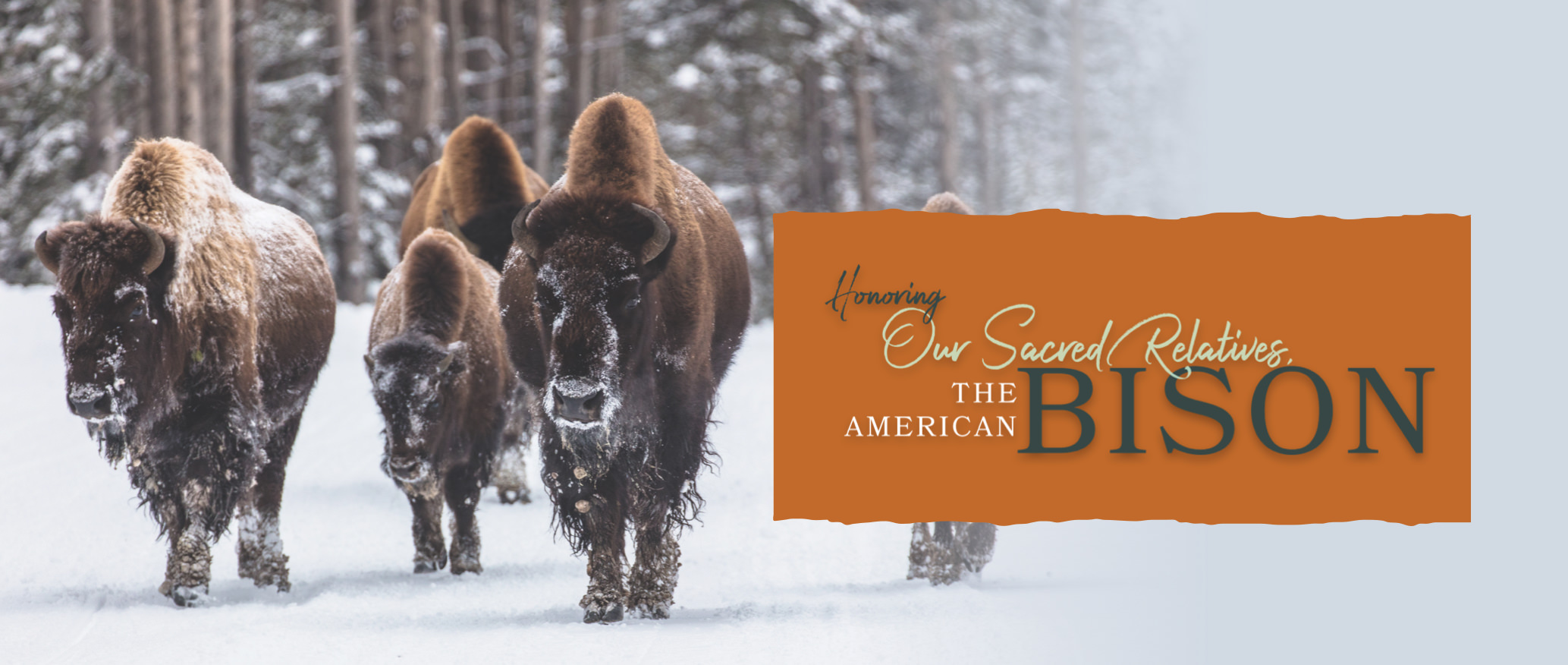
The American bison is the official national mammal of the United States, designated in 2016 by former President Barack Obama when he signed the National Bison Legacy Act into law. The organized reintroduction and conservation of the American bison began in 1905 with the formation of the American Bison Society, and today there are an estimated 350,000 to 400,000 plus bison in North America.
That progress is being tested again: an ongoing federal court battle in Montana centers on whether a bison herd can keep grazing on public land it has occupied for years — the latest round in a century-old fight over who gets to decide the bison’s fate.
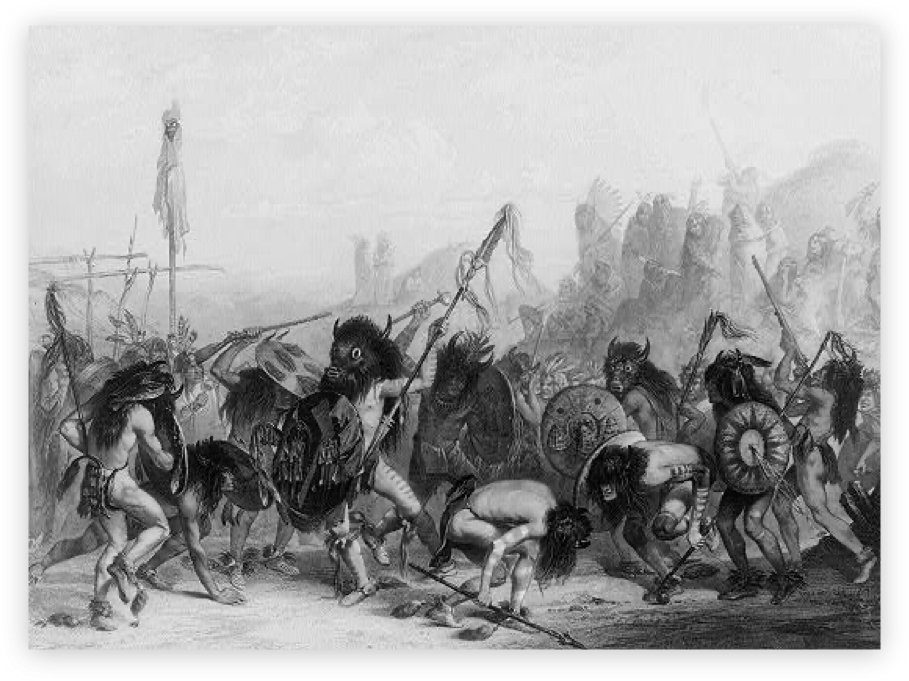
Bison dance of the Mandan Indians in front of their medicine lodge. In Mihtutta-Hankush.
Photo Courtesy of Library of Congress Prints and Photographs Division Washington, D.C. 20540 USA
Photo Courtesy of Library of Congress Prints and Photographs Division Washington, D.C. 20540 USA
A note on language: the animals commonly called buffalo in North America are American bison. French and English explorers called them “les boeufs” or “buffles”; Indigenous nations have their own names for the animal, such as “tatanka” in Lakota, and in many Plains languages the word doubles as a synonym for life itself. Many Indigenous people today use the word “buffalo” to refer to bison because it was adopted into common English and historical use.
“Buffalo were not just our food,” said Jill Falcon Ramaker, Turtle Mountain Anishinaabe and assistant professor of community nutrition and sustainable food systems at Montana State University. She also directs the university’s Buffalo Nations Food System Initiative. “They were also at the heart of all our ceremonies. And they were the ones that protected us in that they clothed us,” she added.
“Buffalo were not just our food,” said Jill Falcon Ramaker, Turtle Mountain Anishinaabe and assistant professor of community nutrition and sustainable food systems at Montana State University. She also directs the university’s Buffalo Nations Food System Initiative. “They were also at the heart of all our ceremonies. And they were the ones that protected us in that they clothed us,” she added.
For many Indigenous nations, buffalo were the center of life. People moved with the buffalo. They had a mobile life that was tuned into the rhythm of the seasons. They moved with the herds, tending the land, and harvesting wild foods other than buffalo. Buffalo hides were used for lodges. All parts of the bison were used for tools.
Indigenous land-management practices, particularly the use of strategic controlled burns, helped shape and maintain the vast grasslands that sustained millions of bison. This active stewardship, combined with a semiarid rain-shadow climate, deep-rooted perennial grasses, and nutrient-rich soils, created a powerful symbiotic relationship that allowed bison populations to thrive at an unprecedented scale.. “They were really the heart of our way of life and our belief,” Ramaker said.
To Indigenous people, the buffalo is recognized as a sacred relative, and survival was viewed as a mutual agreement. In an interview with Explore Yellowstone, Ramaker shared that the Anishinaabe have a traditional story about Geshe Bishiki, grandfather buffalo. Ultimately, his disappearance in that story points to Indigenous people who forgot to listen to their elders, who forgot to perform their ceremonies, who abandoned the buffalo culture, teachings, their spirituality, their way of life.
“They weren’t just a source of food,” she said. “They were our kin, our bigger, older relative who looked out for us.”
According to Ramaker, in order to understand what buffalo culture is, we must understand an Indigenous way of seeing the world, an Indigenous worldview that is completely different than the dominant worldview and the dominant economy.
“We see our relatives that are not human as our older than human relatives,” Ramaker said. “They’re older because we understand we were the last ones to be brought to this realm.”
In this Indigenous worldview, kinship is everything.
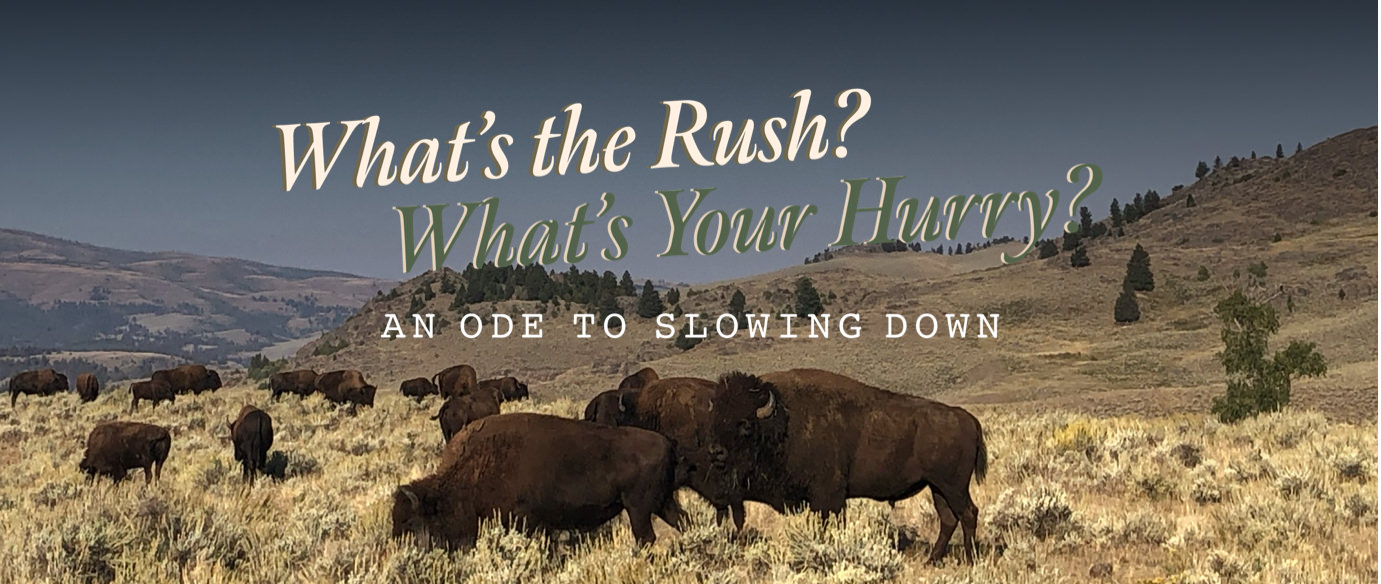
As a keystone species—an organism whose presence holds an entire ecosystem together—bison dramatically improve their environment when allowed to roam freely. They create a “mosaic” effect — grazing some areas short and leaving others tall, which Beth Saboe, Director of Public Affairs at American Prairie, calls “a bad haircut on the prairie.” This patchwork of grass heights gives different bird species places to nest. Bison wallows — shallow depressions left behind — collect rainwater and bison-fur seeds, creating mini wetlands that support amphibians, birds, and insects. In winter, their heads act as snowplows, clearing paths through snow so smaller animals can reach the grass beneath. Even in death, bison sustain the ecosystem: scavengers feed on their remains, while decomposing bones and flesh enrich the soil with nitrogen and phosphorus.
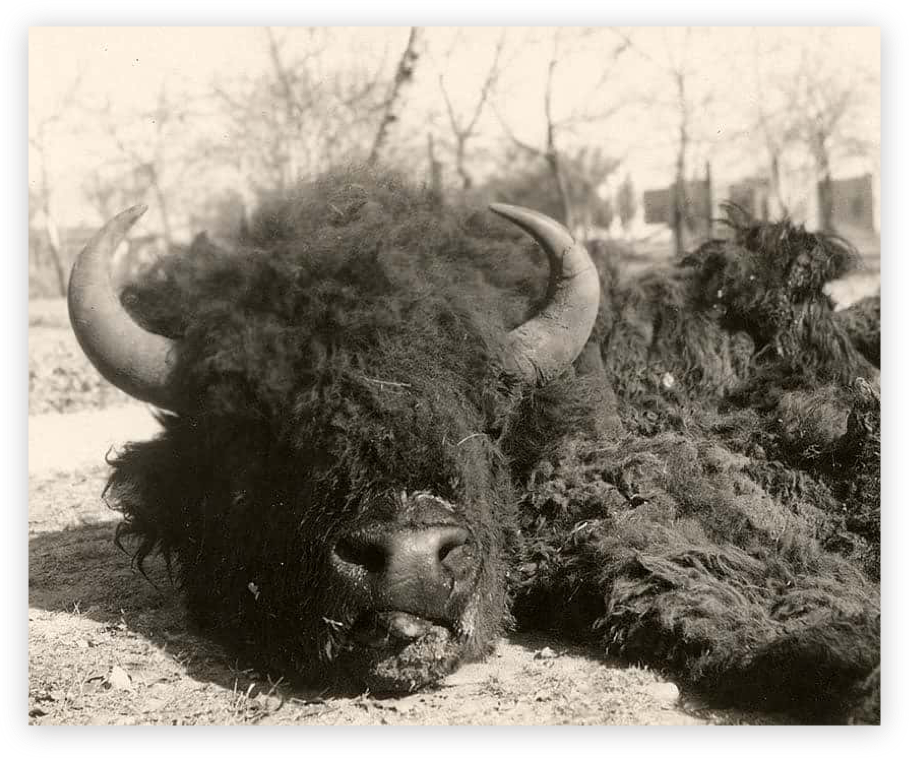
Buffalo hide presented to Lone Wolf, ca. 1925–1935. Photo Courtesy of MS 320 Paul Dyck Plains Indian Buffalo Culture Collection
But those ecological relationships once played out on a scale that is difficult to imagine today.
Millions of bison moved across North America, shaping the landscape as they went. By the end of the 19th century only a few hundred bison were left..
Reports from the North American frontier in 1886 made it clear that the bison was about to be extinguished. Some saw the fate of the bison as a sad but inevitable footnote to the tale of national expansion.
“The bison has had his day, and now he must make room for some of his remote relations who have come to take his place,” wrote the San Francisco Chronicle on February 9, 1890.
That footnote, though, was not only the byproduct of a booming hide trade. U.S. Army leadership saw the herds as a target in their own right: destroying the Plains tribes’ primary food source, they reasoned, would force them onto reservations faster than fighting them directly would. General Philip Sheridan, who led the campaign to pacify the Plains, is widely quoted as having urged hunters to keep killing, arguing that the loss of the buffalo would do more to end Indigenous resistance than the Army itself could. Historians have since described the extermination not as an accident of market forces but as a deliberate strategy of conquest aimed at Indigenous nations.
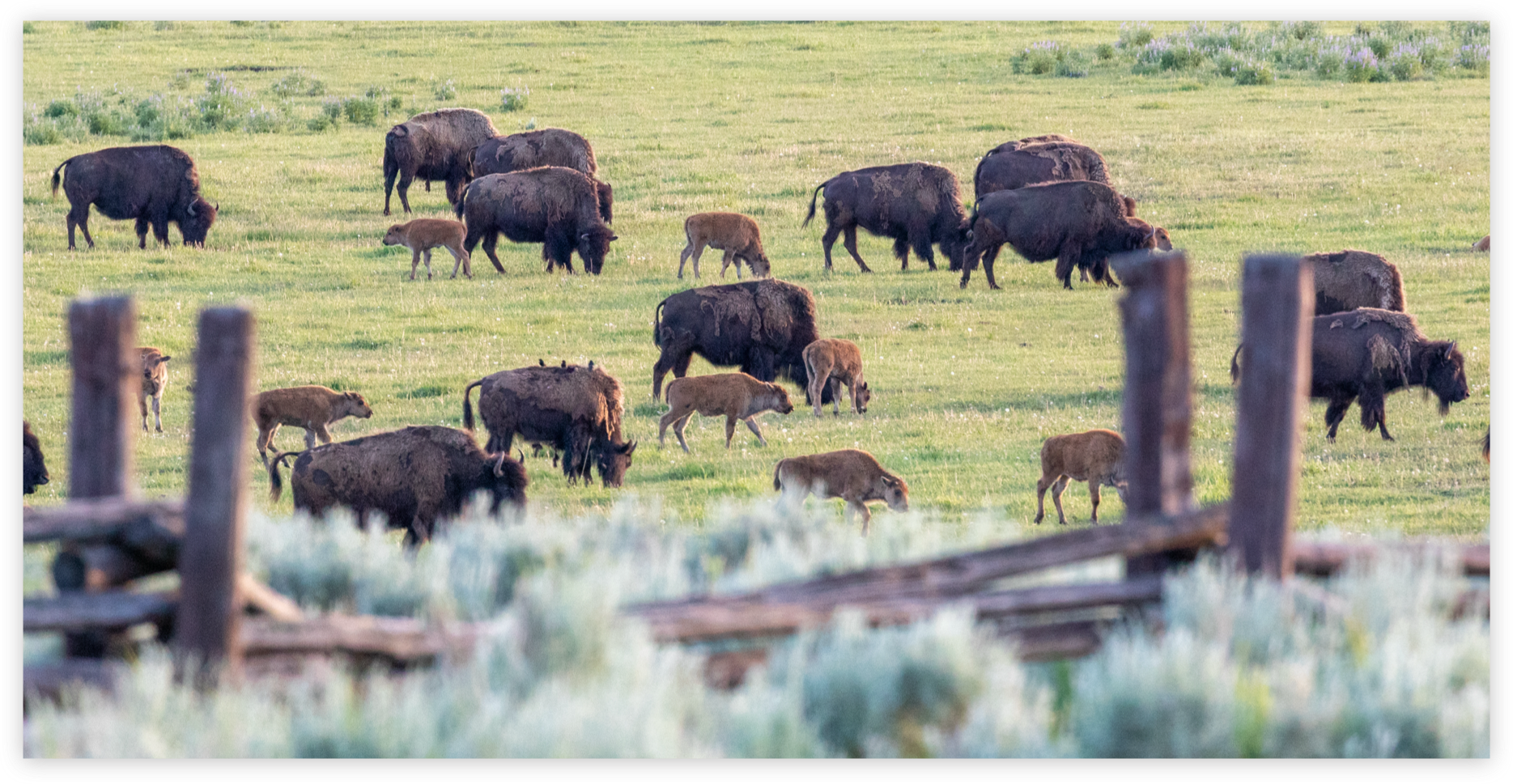
Bison herd with calves passing by the Lamar Buffalo Ranch in Lamar Valley in late afternoon Photo By Yellowstone Forever / Matt Ludin
Animal welfare societies expressed outrage at the sickening scenes of slaughter happening on the plains. But, for many Americans, what was happening to bison was an abstraction that they couldn’t identify with.
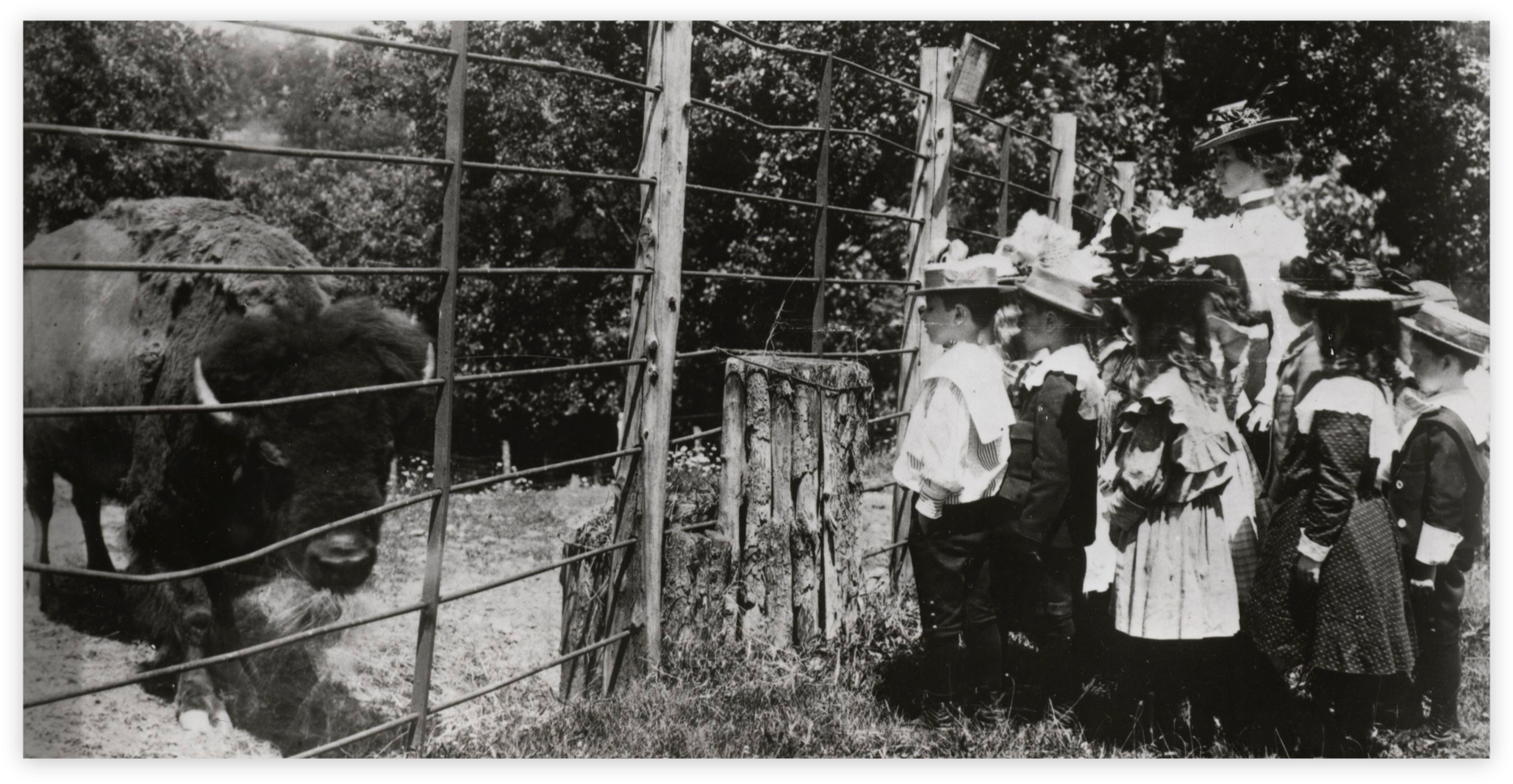
Amidst the rapid westward expansion of the 1800s, an unexpected advocate for the bison emerged, William Hornaday: a taxidermist and avid big-game hunter, who had rarely paused to wonder about a species’ longevity. When Hornaday arrived at the National Museum in Washington D.C. in 1882, he was surprised to discover that the institution had only a few moth-eaten specimens of Bison bison. This prompted him to write to contacts across the Great Plains about the prospect of acquiring more, only to discover that there were now few, if any, free-roaming bison left alive in the western United States. He described being “scandalized” by the gore and waste reported by his contacts on the plains. The reports prompted Hornaday to head to Montana himself to collect and preserve at least a few of the remaining representatives of Bison bison behind glass.
Amidst the rapid westward expansion of the 1800s, an unexpected advocate for the bison emerged, William Hornaday: a taxidermist and avid big-game hunter, who had rarely paused to wonder about a species’ longevity. When Hornaday arrived at the National Museum in Washington D.C. in 1882, he was surprised to discover that the institution had only a few moth-eaten specimens of Bison bison. This prompted him to write to contacts across the Great Plains about the prospect of acquiring more, only to discover that there were now few, if any, free-roaming bison left alive in the western United States. He described being “scandalized” by the gore and waste reported by his contacts on the plains. The reports prompted Hornaday to head to Montana himself to collect and preserve at least a few of the remaining representatives of Bison bison behind glass.
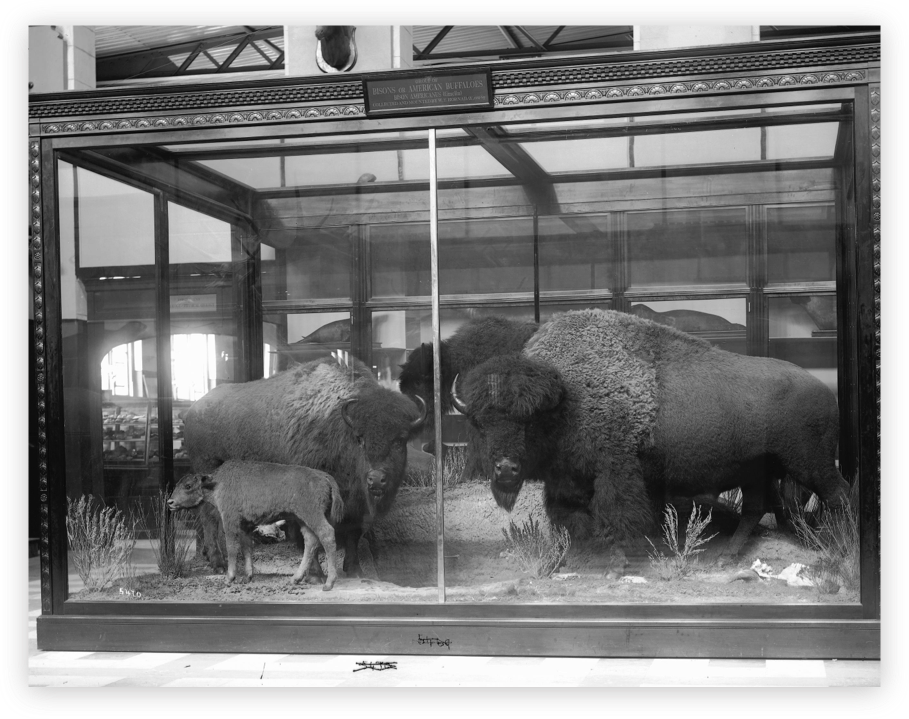
Bison exhibit, South Hall of the US National Museum, by Unknown, c. 1887 Photo Courtesy of Smithsonian Institution Archives
During his foray into Montana, he and his party killed 24 bison, with the final kill being the largest, later to be displayed as a central figure in the National Museum. He felt that bringing the bison to the masses would expand their worldview to the bison’s predicament. However, he didn’t stop there. He envisioned the formation and preservation of a herd of live buffaloes to “atone for the national disgrace” that was their extermination.
Hornaday channeled his guilt and outrage into a landmark 1889 report, “The Extermination of the American Bison.” In it, he sounded an urgent national alarm: the last remaining wild, naturally occurring bison in the United States were hiding in the valleys of Yellowstone National Park, and poachers were systematically wiping them out.
Hornaday channeled his guilt and outrage into a landmark 1889 report, “The Extermination of the American Bison.” In it, he sounded an urgent national alarm: the last remaining wild, naturally occurring bison in the United States were hiding in the valleys of Yellowstone National Park, and poachers were systematically wiping them out.
His fierce public lobbying worked. It directly pressured Congress into passing the Lacey Act of 1894 to protect Yellowstone’s wildlife, but by 1901, the park’s wild herd had plummeted to a mere 25 survivors. To prevent total extinction, Congress stepped in again in 1902, appropriating $10,000 to purchase bison from private ranches to supplement the survivors.
Brought to the park’s Lamar Buffalo Ranch, these bison were carefully bred and eventually released to roam free. Today, those 25 survivors and their introduced counterparts have grown into a thriving wild population of thousands.
It was the second time humans had determined the species’ fate outright — this time through preservation rather than extermination.
Decades after reintroduction, the work continues just beyond the park’s borders, as Indigenous nations look to the lessons of the past to forge a shared future with their sacred relative.
“I call them the mother herd,” Ramaker said, referring to the Yellowstone bison. Today’s roughly 5,000 bison descend from Yellowstone’s surviving wild herd and the animals later brought in to rebuild the population. To Native American nations, Ramaker said, the herd represents an ancestral root — a living lineage that survived the trauma of the 19th century alongside Indigenous peoples.
Ramaker explained that the onus is on Indigenous people and communities to come home to the buffalo. The work, education, and research she takes part in is aligned with the Buffalo Treaty. The Buffalo Treaty is a historic, cross-border agreement signed in September 2014 by Indigenous nations from the U.S. and Canada to restore wild buffalo to their ancestral lands. Growing from eight to over 40 signatory nations, the alliance focuses on ecological restoration, cultural renewal, and tribal food sovereignty.
Today, that legacy is driving a historic movement of cultural renewal. Through the Bison Conservation Transfer Program — a collaboration between the park, conservationists, and tribes — disease-free bison from this original lineage are being relocated directly to Indigenous communities.
Today, that legacy is driving a historic movement of cultural renewal. Through the Bison Conservation Transfer Program — a collaboration between the park, conservationists, and tribes — disease-free bison from this original lineage are being relocated directly to Indigenous communities.
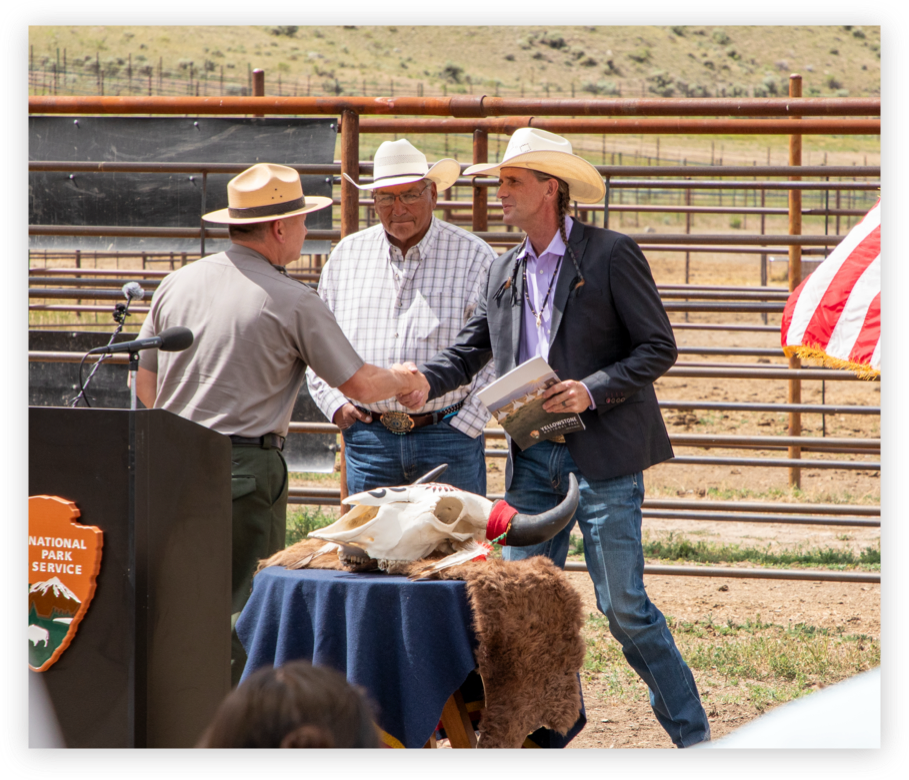
Bison Conservation Transfer Facility Expansion: remarks by Troy Heinert, Executive Director,
InterTribal Buffalo council, Sicangu Lakota. Photo By Yellowstone Forever / Matt Ludin
InterTribal Buffalo council, Sicangu Lakota. Photo By Yellowstone Forever / Matt Ludin
Still, even those closest to the work are careful not to call this a finished story. Asked whether bison restoration amounts to a full recovery, both Ramaker and Saboe said “no.” Historically, tens of millions of bison moved across the Great Plains; today’s several hundred thousand, spread across North America, are a fraction of that.
“I think that it’s a drop in the bucket, and we’re getting started,” Ramaker said. A few thousand animals divided across “postage stamp properties” scattered over the landscape can’t do the ecological or cultural work that tens of millions once did, she said. That will take large, contiguous parcels where bison can be wild and free-roaming again, the kind of connected range American Prairie and others are trying to build one purchase at a time.
“I don’t think there’s a lack of public support for bison,” Saboe said. The obstacles she sees are structural: fragmented land ownership that breaks up the large, connected ranges bison need, and, increasingly, political resistance to growing their populations on public land, particularly in Montana. She’s optimistic about the role of Indigenous nations in that next chapter, pointing to tribes working to grow their own herds for both conservation and food sovereignty.
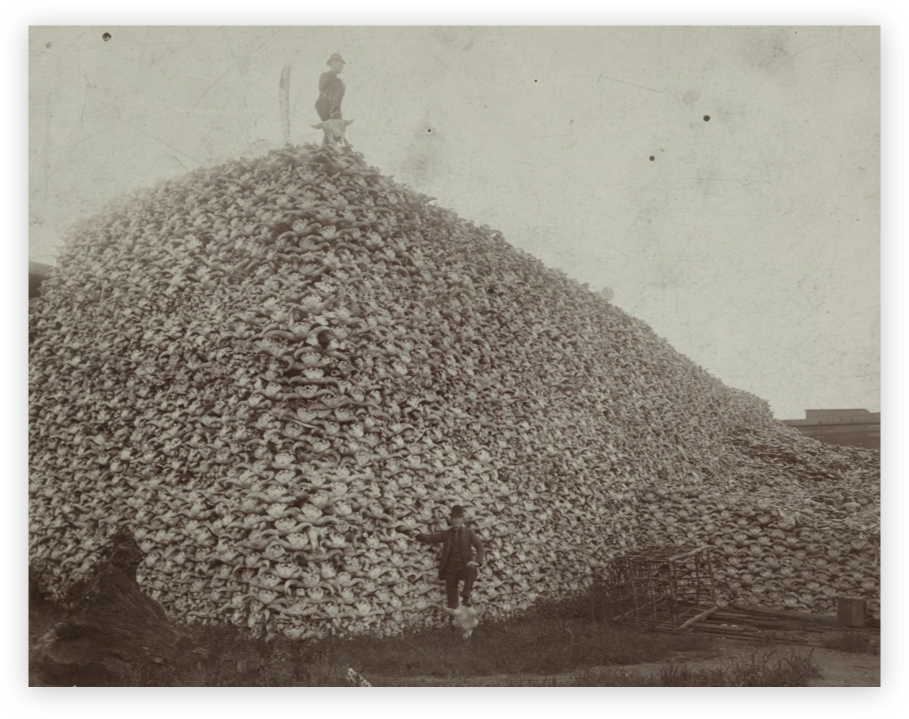
Men standing with pile of buffalo skulls, Michigan Carbon Works, Rougeville MI, 1892.
Photo Courtesy of Burton Historical Collection, Detroit Public Library
Photo Courtesy of Burton Historical Collection, Detroit Public Library
The fight over bison’s place on public land is not over.
In May 2026, the Bureau of Land Management (BLM) rescinded American Prairie’s grazing permits on federal allotments in Phillips County, Montana, ordering the bison removed by Sept. 30, 2026. BLM’s reasoning turned on definition: it concluded that American Prairie manages its bison primarily for conservation and ecological restoration rather than as “production-oriented” livestock, and that under its interpretation of the 1934 Taylor Grazing Act, animals managed that way don’t qualify for grazing permits.
Saboe called the interpretation both unusual and destabilizing. “It certainly inserts confusion into a system and a federal act that has been interpreted and followed the same way since 1934 up until now,” she said. American Prairie and conservation groups counter that bison are livestock under federal grazing law, and that a conservation purpose doesn’t disqualify an otherwise lawful grazing operation.
On Sept. 4, 2026, the dispute took a consequential turn. A federal district court judge in Great Falls granted American Prairie a preliminary injunction, meaning its bison do not have to leave those allotments by the Sept. 30 deadline while the underlying lawsuit proceeds. In issuing it, Judge Brian Morris rejected BLM’s argument that the Taylor Grazing Act requires livestock to be managed exclusively for commercial production and found American Prairie likely to succeed on the merits of its case. It is not a final ruling. But for now, the bison stay.
“It’s unfortunate to see bison become a political football,” Saboe said. Even so, she described the public response to the fight as a source of momentum: people learning what was at stake, she said, “put some wind in our sails.” American Prairie is 25 years into a mission it expects will take decades more. “We’re in it for the long haul,” she said, “but I think what feels really good is to know that we’re not alone in this fight, and we feel like we’re on the right side of it.”
That fight is only the latest chapter in a much older pattern. For thousands of years, humans have determined the bison’s fate: first through Indigenous land-management practices that helped sustain vast herds, then by hunting the species to the edge of extinction, later by deliberately engineering its return through preserved bloodlines, fences and federal law, and now by litigating, allotment by allotment, where that return is allowed to continue.
This is not the same country that let the herds fall to a few hundred animals by 1900. But the bison’s future still rests, as it always has, on decisions made by people, which is exactly why Ramaker calls the relationship a covenant, and why American Prairie keeps fighting for allotments in Phillips County.
As America marks 250 years, the bison’s story remains what it has always been: unfinished, and up to the people still fighting for their return.