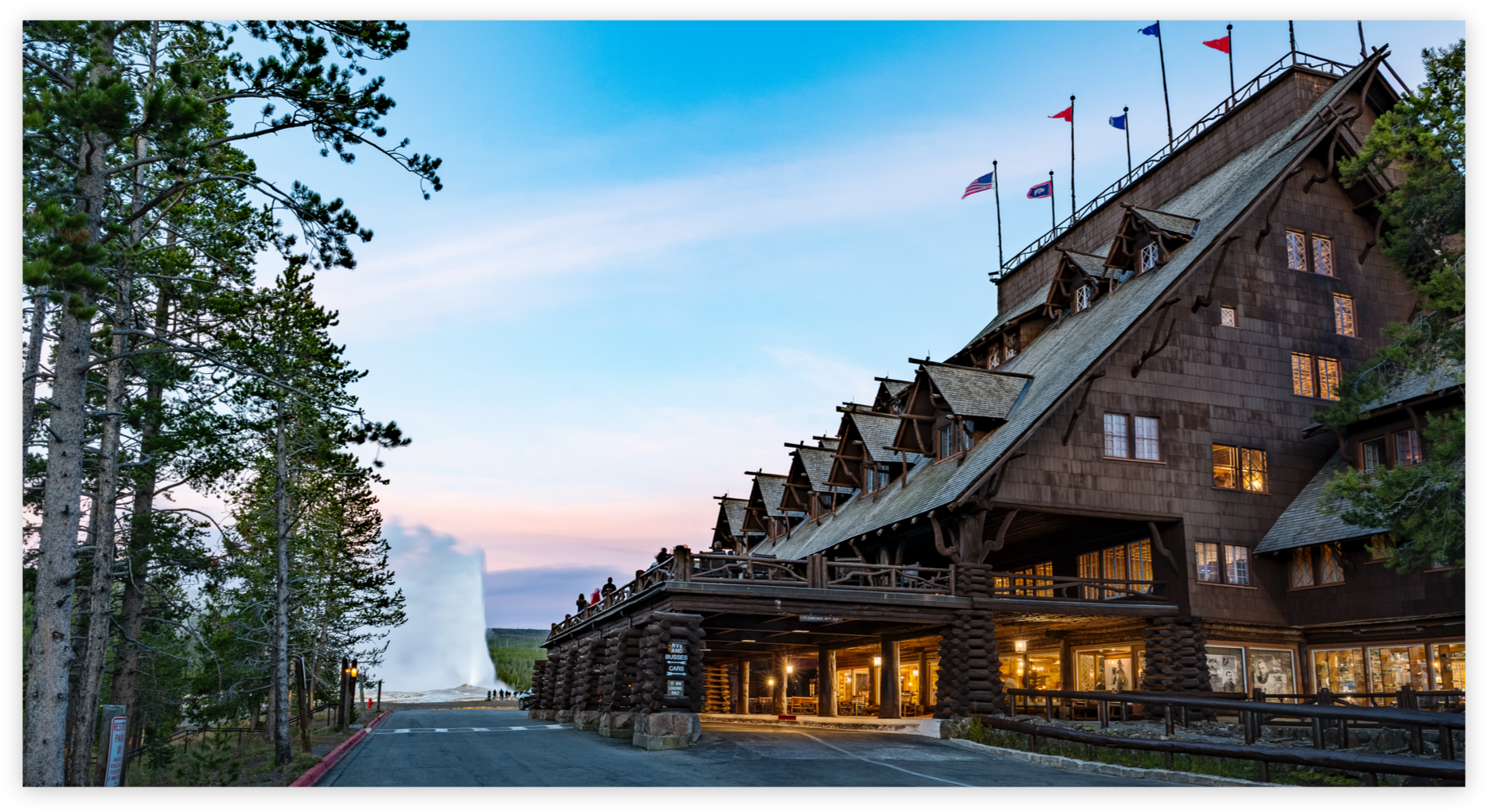
Old Faithful Inn at Yellowstone National Park. PHOTO COURTESY OF XANTERRA TRAVEL COLLECTION

By Taylor Owens
Geremia walks with fellow bison biologist Doug Blanton in Yellowstone National Park’s Stephens Creek bison facility. Photo by Jacob W. Frank
There are countless ways to explore Yellowstone National Park. Some visitors rush through in a single day, stopping at famous viewpoints before heading back out the gates. But one of the most immersive ways to experience the world’s first national park is by traveling slowly and moving from village to village and staying inside the park itself.
Many of those historic lodges and visitor villages are operated by Xanterra Travel Collection, which manages several of the park’s most iconic properties.
For Todd Walton, director of marketing and sales at Yellowstone National Park Lodges, the ideal Yellowstone road trip is about more than checking off landmarks. It’s about stepping beyond the roadside crowds.
Many of those historic lodges and visitor villages are operated by Xanterra Travel Collection, which manages several of the park’s most iconic properties.
For Todd Walton, director of marketing and sales at Yellowstone National Park Lodges, the ideal Yellowstone road trip is about more than checking off landmarks. It’s about stepping beyond the roadside crowds.
“Once you get a couple hundred yards off a trail, you're not going to see a lot of people,” Walton says.
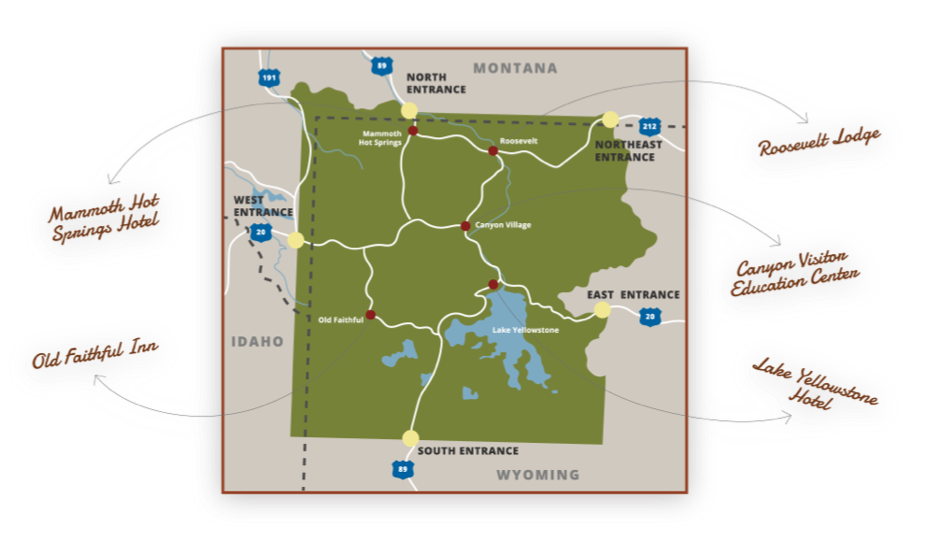
Starting from the North Entrance near Gardiner, Montana, Walton suggests a route that loops through Yellowstone’s northern wildlife valleys, historic lodges, and famous geyser basins—giving travelers a chance to experience both the upper and lower loops of the park.
Just inside the north entrance lies Mammoth Hot Springs, where steaming terraces of white limestone cascade down the hillside. “It is one of the most unique geothermal features in the park,” Walton says. “It’s just a beautiful, beautiful spot.”
The nearby Mammoth Hot Springs Hotel makes an ideal first stop. Renovated in 2019, the property is reminiscent of the park’s historic character with one of its most interesting features being the Map Room.
“The map room has got a beautiful wooden historic map of the United States made with wood from different areas,” Walton says. The handcrafted map even contains a small challenge for observant visitors. “There are a couple of mistakes on the map… I know there are two, but I've heard there are three.”
Starting from the North Entrance near Gardiner, Montana, Walton suggests a route that loops through Yellowstone’s northern wildlife valleys, historic lodges, and famous geyser basins—giving travelers a chance to experience both the upper and lower loops of the park.
Just inside the north entrance lies Mammoth Hot Springs, where steaming terraces of white limestone cascade down the hillside. “It is one of the most unique geothermal features in the park,” Walton says. “It’s just a beautiful, beautiful spot.”
The nearby Mammoth Hot Springs Hotel makes an ideal first stop. Renovated in 2019, the property is reminiscent of the park’s historic character with one of its most interesting features being the Map Room.
“The map room has got a beautiful wooden historic map of the United States made with wood from different areas,” Walton says. The handcrafted map even contains a small challenge for observant visitors. “There are a couple of mistakes on the map… I know there are two, but I've heard there are three.”
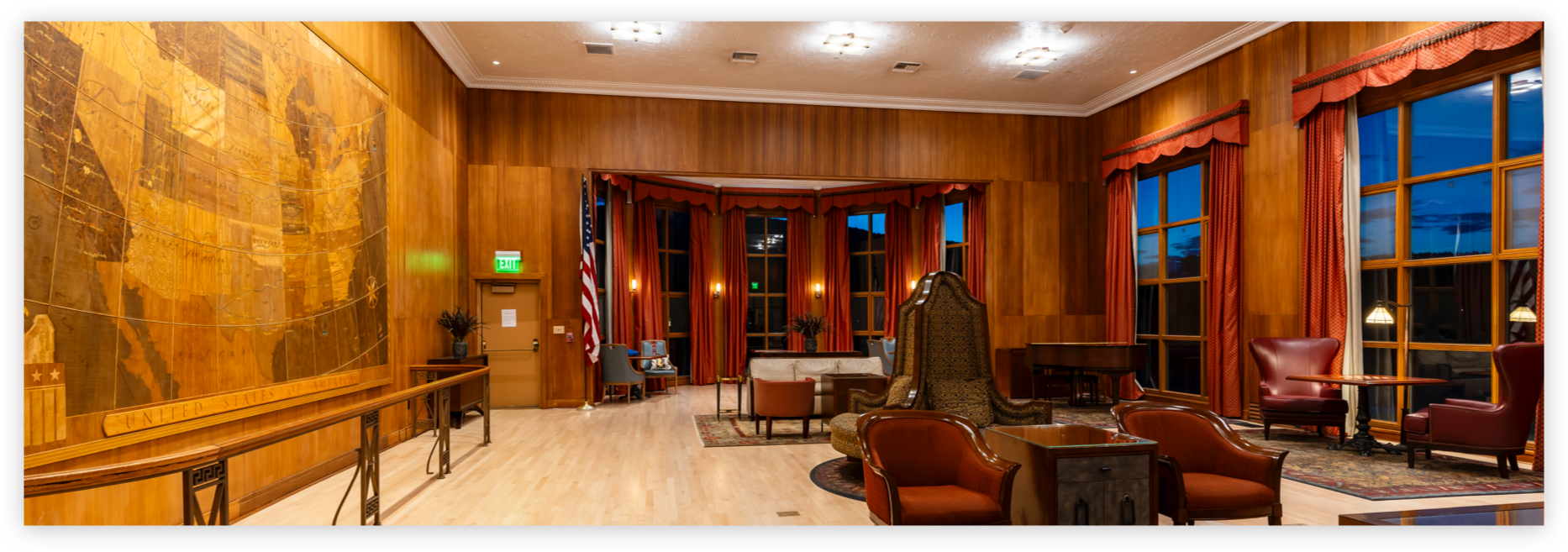
Mammoth Hot Springs Hotel’s Map Room. Photo courtesy of Xanterra Travel Collection
Outside the hotel, Mammoth’s boardwalk trails wind through steaming terraces and scenic overlooks that provide views of both the geothermal formations and the historic Fort Yellowstone district.
“It's a great opportunity to see a lot of wildlife,” Walton says. Travelers can also begin their wildlife adventures nearby in Lamar Valley, one of the park’s most famous wildlife habitats.
From Mammoth, the road continues east toward Roosevelt Lodge, a collection of rustic cabins that reflect Yellowstone’s frontier-era roots. The lodge is named for President Theodore Roosevelt, who once camped nearby during his visits to the park.
Today, the property offers a quieter and more relaxed atmosphere than some of Yellowstone’s busier villages. Guests can spend the evening enjoying dinner, visiting the whiskey bar, or relaxing on the lodge’s wide wooden porch overlooking the surrounding landscape.
“I've heard it said that it's the best porch in the park,” Walton says.
“It's a great opportunity to see a lot of wildlife,” Walton says. Travelers can also begin their wildlife adventures nearby in Lamar Valley, one of the park’s most famous wildlife habitats.
From Mammoth, the road continues east toward Roosevelt Lodge, a collection of rustic cabins that reflect Yellowstone’s frontier-era roots. The lodge is named for President Theodore Roosevelt, who once camped nearby during his visits to the park.
Today, the property offers a quieter and more relaxed atmosphere than some of Yellowstone’s busier villages. Guests can spend the evening enjoying dinner, visiting the whiskey bar, or relaxing on the lodge’s wide wooden porch overlooking the surrounding landscape.
“I've heard it said that it's the best porch in the park,” Walton says.
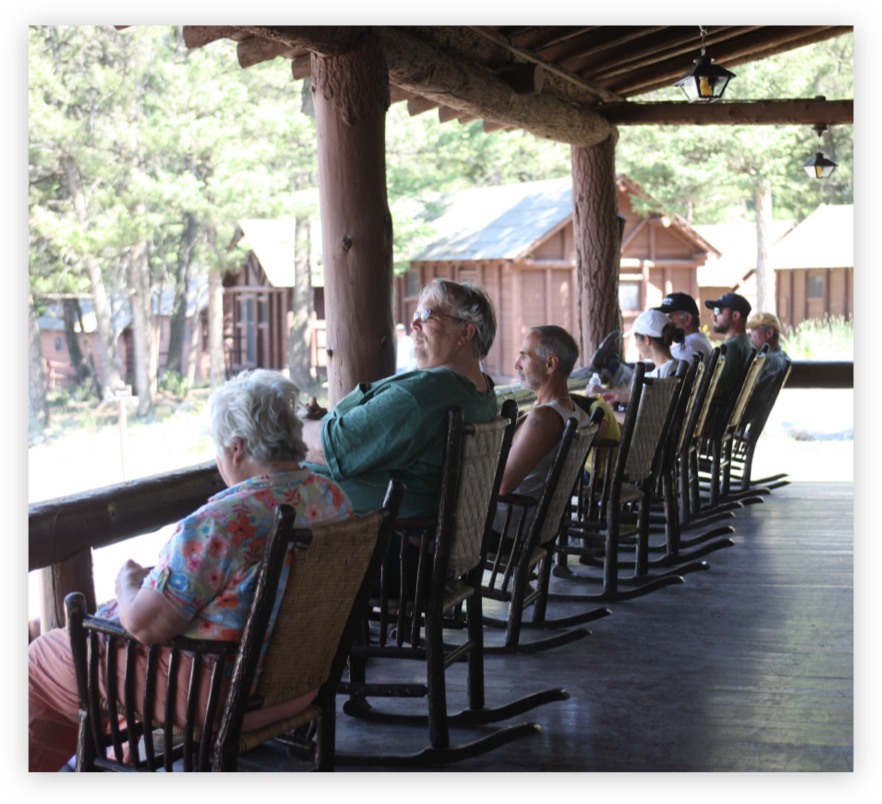
Roosevelt Lodge, visitors sitting in rocking chairs on porch. Photo Courtesy of YNP / Jody Lyle
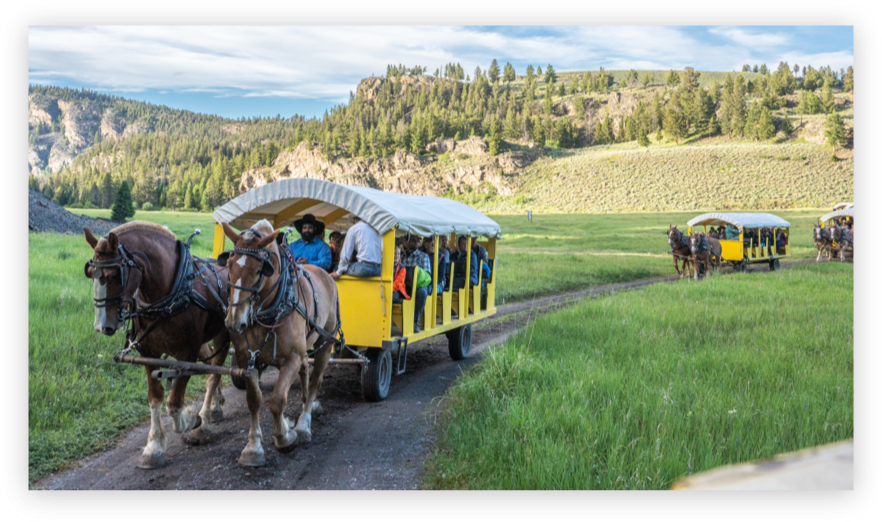
For visitors seeking a unique Western-style adventure, Roosevelt Lodge also hosts the Roosevelt Cookout, where guests can travel by stagecoach into the backcountry for a traditional cowboy-style dinner.
Continuing south from Roosevelt, the road climbs toward Dunraven Pass, one of Yellowstone’s highest scenic drives. From here, travelers can access trails leading to Mount Washburn, which offers sweeping panoramic views across the park.
Descending from the pass brings visitors to Canyon Village, where the park’s visitor center offers exhibits about Yellowstone’s geology, wildlife, and history.
The drive between Canyon and the lake passes through Hayden Valley, another prime wildlife habitat where bison herds often roam the open grasslands.
“You can see incredible things from the car driving through Hayden Valley or driving out towards Lamar Valley,” Walton says.
Still, he encourages visitors to explore beyond the roadside. “Only four or five percent of people get within a couple hundred yards of their car,” he says. “If you're going to do a road trip, getting out of the car is the way to do it.”
Continuing south from Roosevelt, the road climbs toward Dunraven Pass, one of Yellowstone’s highest scenic drives. From here, travelers can access trails leading to Mount Washburn, which offers sweeping panoramic views across the park.
Descending from the pass brings visitors to Canyon Village, where the park’s visitor center offers exhibits about Yellowstone’s geology, wildlife, and history.
The drive between Canyon and the lake passes through Hayden Valley, another prime wildlife habitat where bison herds often roam the open grasslands.
“You can see incredible things from the car driving through Hayden Valley or driving out towards Lamar Valley,” Walton says.
Still, he encourages visitors to explore beyond the roadside. “Only four or five percent of people get within a couple hundred yards of their car,” he says. “If you're going to do a road trip, getting out of the car is the way to do it.”
Continuing south brings travelers to the shoreline of Yellowstone Lake. Overlooking the water is the elegant Lake Yellowstone Hotel, one of the park’s most recognizable historic buildings. Redesigned and expanded upon in 1903 by park architect Robert Reamer, the hotel has welcomed visitors for more than a century.
Large windows in the sunroom frame views of the lake, making it a peaceful place to relax after a day of exploring nearby trails or taking a scenic boat cruise from nearby Bridge Bay Marina.
“The sunroom is an amazing place to just have a cocktail,” Walton says.
From the lake, the road curves west toward West Thumb Geyser Basin, where geothermal pools bubble along the shoreline.
The journey eventually reaches Yellowstone’s most famous geothermal attraction: Old Faithful.
Nearby stands the towering log structure of the Old Faithful Inn, another landmark designed by Robert Reamer. Guests staying here are just steps away from one of the most iconic geysers in the world.
Not far away, the brilliant colors of Grand Prismatic Spring draw photographers and visitors from around the globe.
Large windows in the sunroom frame views of the lake, making it a peaceful place to relax after a day of exploring nearby trails or taking a scenic boat cruise from nearby Bridge Bay Marina.
“The sunroom is an amazing place to just have a cocktail,” Walton says.
From the lake, the road curves west toward West Thumb Geyser Basin, where geothermal pools bubble along the shoreline.
The journey eventually reaches Yellowstone’s most famous geothermal attraction: Old Faithful.
Nearby stands the towering log structure of the Old Faithful Inn, another landmark designed by Robert Reamer. Guests staying here are just steps away from one of the most iconic geysers in the world.
Not far away, the brilliant colors of Grand Prismatic Spring draw photographers and visitors from around the globe.
While many visitors choose lodging outside the park in communities such as West Yellowstone, Montana, or Cody, Wyoming, but staying inside the park’s boundaries changes the pace of the experience.
“Staying in the park really allows you that extra time to enjoy being there,” Walton says. “You don't have to rush to get into the park and hurry up to get somewhere. You're already there.”
Guests staying within the park can avoid the morning traffic at park entrances and have easier access to tours, hikes, and ranger programs.
For many visitors, Yellowstone’s most memorable moments are often the simplest, like watching wildlife move across a valley, listening to geysers hiss in the distance, or sitting quietly on a lodge porch as evening settles over the landscape.
“Staying in the park really allows you that extra time to enjoy being there,” Walton says. “You don't have to rush to get into the park and hurry up to get somewhere. You're already there.”
Guests staying within the park can avoid the morning traffic at park entrances and have easier access to tours, hikes, and ranger programs.
For many visitors, Yellowstone’s most memorable moments are often the simplest, like watching wildlife move across a valley, listening to geysers hiss in the distance, or sitting quietly on a lodge porch as evening settles over the landscape.
Roosevelt Lodge, visitors sitting in rocking chairs on porch. Photo Courtesy of YNP / Jody Lyle
And in a world that rarely slows down, the park still offers something increasingly rare.
“Chances are your cell phone’s not going to work a lot of the places, and that's pretty awesome,” Walton says.
That quiet, he believes, is part of what makes Yellowstone unforgettable.
“Our goal is to provide legendary hospitality,” Walton says. “Yellowstone is the world's first national park… and there are so many stories.”
“Chances are your cell phone’s not going to work a lot of the places, and that's pretty awesome,” Walton says.
That quiet, he believes, is part of what makes Yellowstone unforgettable.
“Our goal is to provide legendary hospitality,” Walton says. “Yellowstone is the world's first national park… and there are so many stories.”