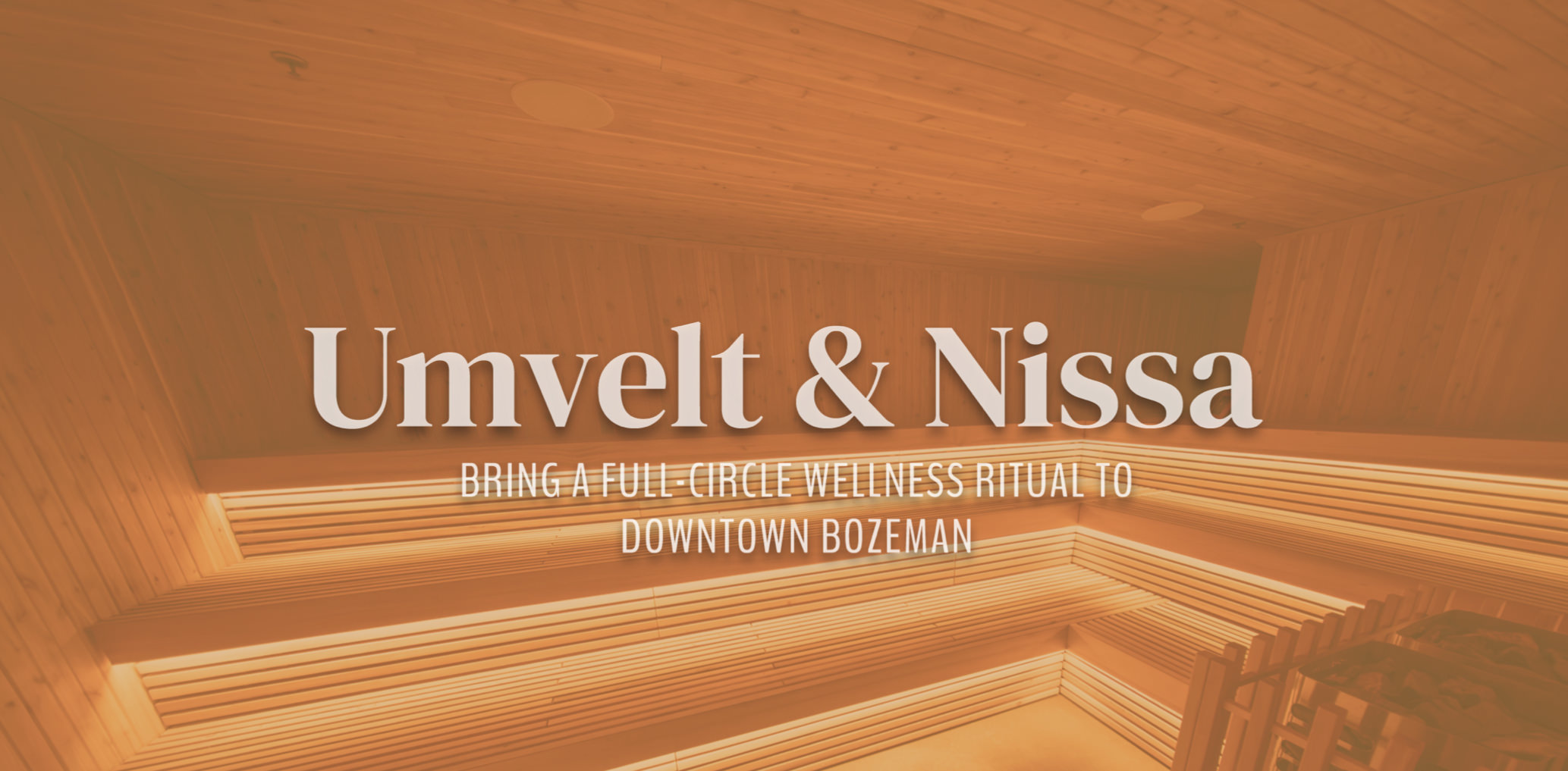
One of the two sauna options at Umvelt. Photos courtesy of Umvelt

By Parker Day
As a mental health therapist, I always have an eye out for wellness opportunities within the community. When I heard about the launch of Umvelt, a new bathhouse in Downtown Bozeman, my therapist senses started tingling. The health benefits of hot and cold intervention are well-known and highly studied, so I was interested to see what this place had to offer.
Umvelt is inspired by the tradition of Banya, a Slavic steam-bathing ritual where bathers cycle between intense heat, cold immersion, and rest to promote physical cleansing, nervous-system regulation, and communal connection. Their bathhouse sports a high-humidity sauna, a Finnish dry sauna, a eucalyptus-infused steam bath, a cold plunge, a warm spa, and is even directly attached to a restaurant, Nissa, that offers to restore you after bathing.
“Umwelt is a German word that we don’t have in English that roughly translates to ‘the sensory environment,’” Paul Byrne told me, the founder and owner of Umvelt. “It’s this idea that every organism is having a different experience of the environment based on its unique
set of senses.”
And every inch of the space seems designed to put the senses at ease. Smokeless incense wafts gently through the air, relaxing music chosen for the particular time of day reverberates through the room, and the whole bathhouse is an enforced technology-free zone. From top to bottom, Umvelt was designed with intention, and that intentionality extends beyond just the physical space.
Umvelt is inspired by the tradition of Banya, a Slavic steam-bathing ritual where bathers cycle between intense heat, cold immersion, and rest to promote physical cleansing, nervous-system regulation, and communal connection. Their bathhouse sports a high-humidity sauna, a Finnish dry sauna, a eucalyptus-infused steam bath, a cold plunge, a warm spa, and is even directly attached to a restaurant, Nissa, that offers to restore you after bathing.
“Umwelt is a German word that we don’t have in English that roughly translates to ‘the sensory environment,’” Paul Byrne told me, the founder and owner of Umvelt. “It’s this idea that every organism is having a different experience of the environment based on its unique
set of senses.”
And every inch of the space seems designed to put the senses at ease. Smokeless incense wafts gently through the air, relaxing music chosen for the particular time of day reverberates through the room, and the whole bathhouse is an enforced technology-free zone. From top to bottom, Umvelt was designed with intention, and that intentionality extends beyond just the physical space.
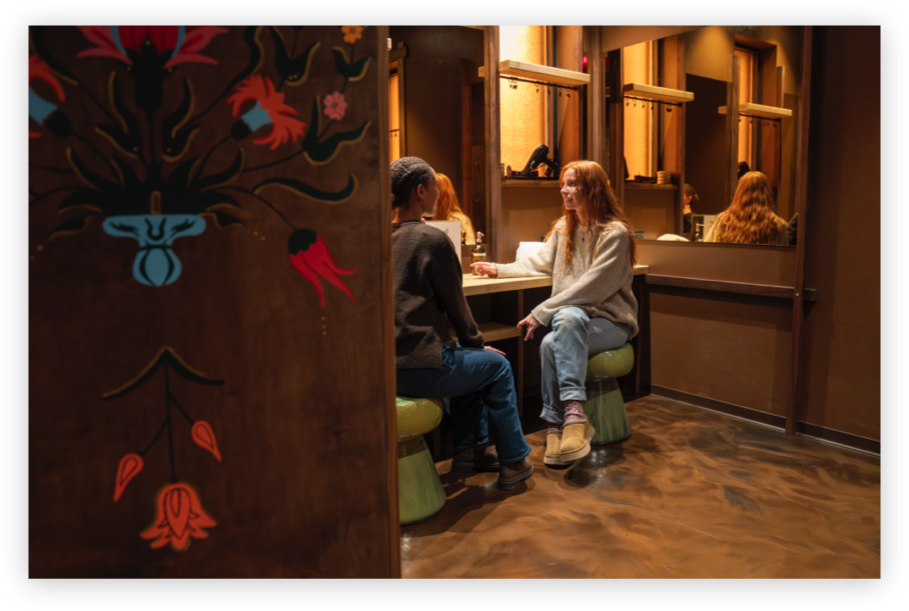
Two guests chatting in the changing room at Umvelt.
Byrne said that Umvelt is trying to really lead with their “Sweatiquette,” a term he credits to Joe Dispenza from Bend Beyond Yoga. Its first line is “Consciousness is awareness, and awareness is paying attention,” and Byrne hopes that Umvelt’s patrons will embody those principles. “It’s a body neutral space, so it’s a space where we’re not going to comment on body types, tattoos, swim suits, anything like that,” Byrne said. “Even if it’s meant in a complimentary way. We’re thinking about our conversations in a small space being overheard, not talking about things that might make other people uncomfortable.”
As a therapist, this is music to my ears. In a world where we are conditioned to notice things about our own bodies and other people’s bodies, it was so refreshing to enter a space encouraging us to rewire our brains and redirect our attention to the sensory experience that Umvelt delivers.
As a therapist, this is music to my ears. In a world where we are conditioned to notice things about our own bodies and other people’s bodies, it was so refreshing to enter a space encouraging us to rewire our brains and redirect our attention to the sensory experience that Umvelt delivers.
“One of my early decisions was not to lean too hard into the science,” Byrne says. “I’m sure I could say you need sauna to survive or whatever. I just know it feels really good, so our motto is ‘feel what’s real.’”
Byrne also said that he wanted to lean away from fear-based marketing: “So much of the longevity movement is half optimistic and half makes you feel bad all the time.”
So a body-neutral space that encourages listening to the natural responses of your body? A space that rejects the kind of marketing that tells you there’s only one way to do things and doesn’t acknowledge the hundreds of differences every gender, race, and being can have? Sounds pretty good to me. But what’s the space actually like?
Inside the bathhouse, there are two saunas—one set to 195 degrees at around 30% humidity and the other set to 175 degrees and left dry. Byrne describes a traditional contrast therapy circuit as five to 15 minutes in one of the thermal rooms, then a mandatory rinse in the showers before cold plunging for anywhere between one and five minutes. Then guests can use the rewarming pool to slowly warm the body back up (he says this naturally tends to be the time to socialize), and repeat for however many times it feels good for their body.
Byrne also said that he wanted to lean away from fear-based marketing: “So much of the longevity movement is half optimistic and half makes you feel bad all the time.”
So a body-neutral space that encourages listening to the natural responses of your body? A space that rejects the kind of marketing that tells you there’s only one way to do things and doesn’t acknowledge the hundreds of differences every gender, race, and being can have? Sounds pretty good to me. But what’s the space actually like?
Inside the bathhouse, there are two saunas—one set to 195 degrees at around 30% humidity and the other set to 175 degrees and left dry. Byrne describes a traditional contrast therapy circuit as five to 15 minutes in one of the thermal rooms, then a mandatory rinse in the showers before cold plunging for anywhere between one and five minutes. Then guests can use the rewarming pool to slowly warm the body back up (he says this naturally tends to be the time to socialize), and repeat for however many times it feels good for their body.
Byrne said that he prioritizes ventilating the saunas to consistently pull fresh air through. “One of the reasons people tend to get headaches or feel faint in saunas is because they aren’t properly ventilated,” Byrne says. “Moving air through keeps [it] fresh and prevents oxygen deprivation.”
Attached to the bathhouse is the restaurant Nissa, owned and run by Bader Labidi and Thibault Vigier-Hervé (who goes by Teebo), two kind-hearted chefs that grew up in Nice, France. Labidi says “Our hope is for people to not feel rushed,” challenging the traditional American style of getting as many customers in and out of a restaurant to create as much revenue as possible. “We want people to really take in what they are eating and experience the food.”
Attached to the bathhouse is the restaurant Nissa, owned and run by Bader Labidi and Thibault Vigier-Hervé (who goes by Teebo), two kind-hearted chefs that grew up in Nice, France. Labidi says “Our hope is for people to not feel rushed,” challenging the traditional American style of getting as many customers in and out of a restaurant to create as much revenue as possible. “We want people to really take in what they are eating and experience the food.”
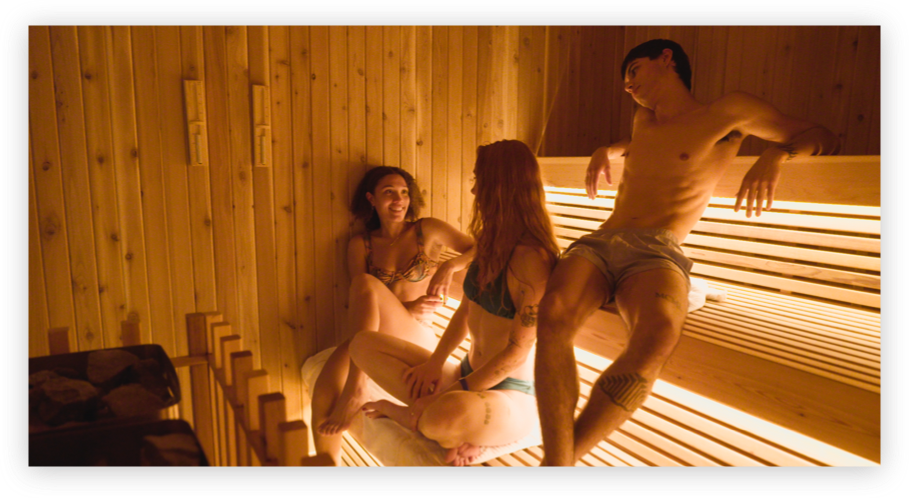
Bathhouse goers seated inside one of the saunas at Umvelt.
Labidi, who’s also the owner of Food for Thought Catering, describes Nissa as “intuition-based cooking,” and their menu is constantly changing. And by constantly, I mean every two weeks. Labidi explains that his philosophy draws from the food traditions of his upbringing, where chefs let seasonal ingredients and the freshest market offerings guide their menus each day.
Like the bathhouse, Nissa is also incredibly intentional. The restaurant encourages a slow-paced experience, body neutral space, and prioritizes the quality of the food going into its customers’ bodies. The chefs even clear each menu with a dietician who lets them know if adjustments should be made to make the food healthier for guests. The restaurant shines with intention, honesty, and truly delicious food.
When I visited Umvelt, I did two contrast circuits in the wet sauna, bracing myself each time I stepped into the cold plunge and fighting to stay in for more than a few seconds. After my circuits, I spent a few minutes breathing eucalyptus in the steam room, then went upstairs for a mocktail at Nissa, a bowl of the best stew I’ve ever had in my life, and some lively conversation with Teebo. I left feeling refreshed and rejuvenated from a very different kind of wellness experience than what I’m used to.
To say I was impressed as a mental health therapist by Umvelt and Nissa is an understatement. The emphasis these two spaces put on slowing down and simply listening to your body felt incredibly rare and unique. Umvelt is a great place to establish an intuitive and somatic routine, and it wasn’t long before I came back for more. In fact, I took a few friends there for dinner later that night, and I think they liked it as much as I did.
Like the bathhouse, Nissa is also incredibly intentional. The restaurant encourages a slow-paced experience, body neutral space, and prioritizes the quality of the food going into its customers’ bodies. The chefs even clear each menu with a dietician who lets them know if adjustments should be made to make the food healthier for guests. The restaurant shines with intention, honesty, and truly delicious food.
When I visited Umvelt, I did two contrast circuits in the wet sauna, bracing myself each time I stepped into the cold plunge and fighting to stay in for more than a few seconds. After my circuits, I spent a few minutes breathing eucalyptus in the steam room, then went upstairs for a mocktail at Nissa, a bowl of the best stew I’ve ever had in my life, and some lively conversation with Teebo. I left feeling refreshed and rejuvenated from a very different kind of wellness experience than what I’m used to.
To say I was impressed as a mental health therapist by Umvelt and Nissa is an understatement. The emphasis these two spaces put on slowing down and simply listening to your body felt incredibly rare and unique. Umvelt is a great place to establish an intuitive and somatic routine, and it wasn’t long before I came back for more. In fact, I took a few friends there for dinner later that night, and I think they liked it as much as I did.