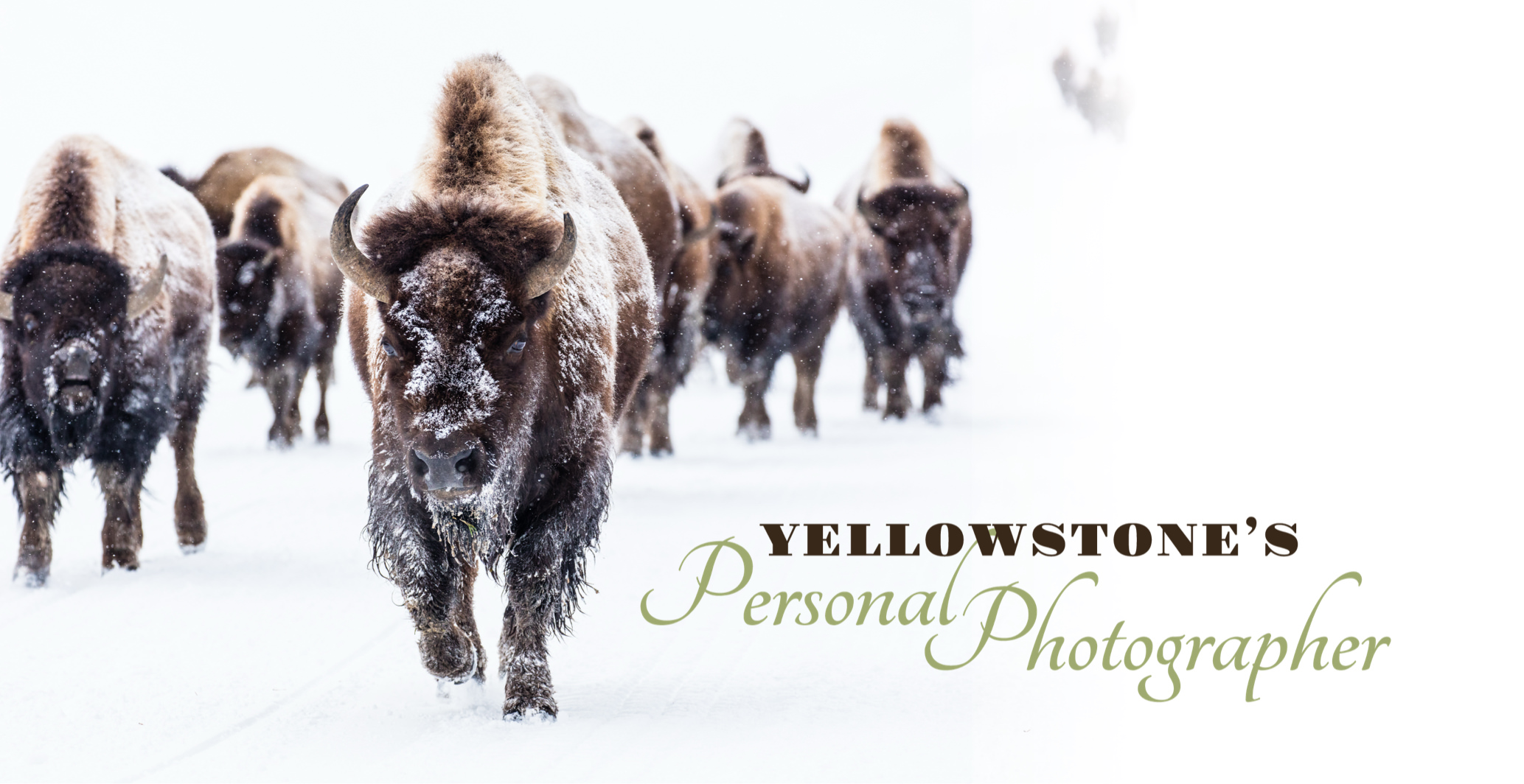
[SNOWY BISON WALKING TO CAMERA] A group of bison walk the snowy road near Frying Pan Spring. Part of Frank’s job is going out in the field with biologists to photograph them as they dart and collar bison and other animals. PHOTO BY JACOB W. FRANK

By Fischer Genau
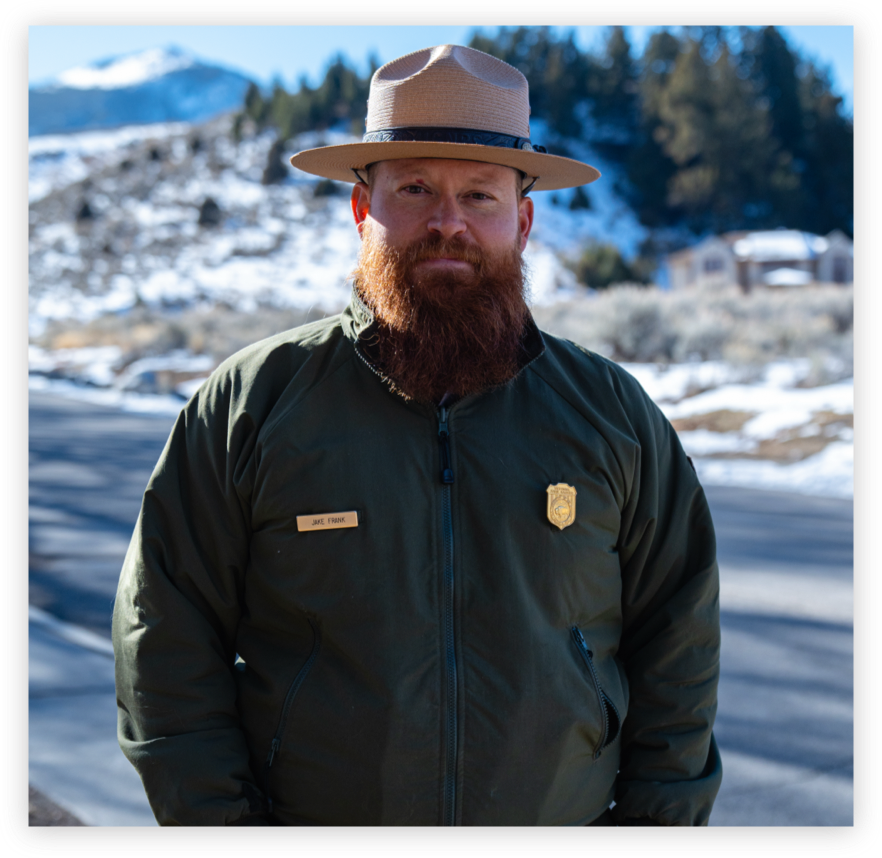
[JAKE PORTRAIT] Ranger Jake outside of Yellowstone’s headquarters at Mammoth Hot Springs. Photo By Fischer Genau
For Jacob W. Frank, the digital communications specialist for Yellowstone National Park, working for Yellowstone is kind of like working at NASA in the 60s. “When you went [there] and you asked the guy mopping the floor, ‘What’s your mission?’ he’d say, ‘We’re putting a man on the moon,’” Frank said. “Everybody felt like part of this larger thing, regardless of what your job was. And I think that’s the same with employees in the Park Service.” Frank has his own mission, and it all started just a few years after he was born.
The first time Frank visited Yellowstone he was a youngster. Born in Billings as a fourth-generation Montanan, Frank and his family moved to Fort Lauderdale, Florida when he was three, but they returned to Montana almost every summer to camp and boat at Canyon Ferry or take Highway 212 through the Beartooth Mountains into Yellowstone.
The first time Frank visited Yellowstone he was a youngster. Born in Billings as a fourth-generation Montanan, Frank and his family moved to Fort Lauderdale, Florida when he was three, but they returned to Montana almost every summer to camp and boat at Canyon Ferry or take Highway 212 through the Beartooth Mountains into Yellowstone.
The first trip to the Park he can remember was when he was eight. Frank and his family, along with a few family friends, stayed in the cabins at Old Faithful for five days, taking hikes and watching water bubble up from the smoking ground. While he was there, his friend’s mom told him that national parks like Yellowstone were so pristine that people could drink right out of the rivers. So, Frank tried it, and a few gulps from the Yellowstone River gave him severe stomach issues for the rest of the trip. “I love telling that story,” Frank said. “Some of the people that come here, they don’t really have any idea what’s safe and not safe.”
After that summer, Frank visited Yellowstone more times than he can count on subsequent family vacations and road trips through high school and college. But he never once thought about working for the Park. “I’d been to Yellowstone so many times, but I didn’t realize that people, like, worked here,” Frank said. “I know that sounds stupid, but I didn’t know what the National Park Service was. We never went to ranger programs. We would just come here and picnic and look at animals and stuff.”
During his senior year at the University of Florida, Frank needed an internship for his degree, and he got a job working “Interp” (which basically means educating and guiding visitors) at Grand Teton National Park for the summer. It was there he would get his first taste of the National Park Service. And it was the beginning of something else too.
After that summer, Frank visited Yellowstone more times than he can count on subsequent family vacations and road trips through high school and college. But he never once thought about working for the Park. “I’d been to Yellowstone so many times, but I didn’t realize that people, like, worked here,” Frank said. “I know that sounds stupid, but I didn’t know what the National Park Service was. We never went to ranger programs. We would just come here and picnic and look at animals and stuff.”
During his senior year at the University of Florida, Frank needed an internship for his degree, and he got a job working “Interp” (which basically means educating and guiding visitors) at Grand Teton National Park for the summer. It was there he would get his first taste of the National Park Service. And it was the beginning of something else too.
Part of Frank’s job was taking visitors on hikes in the park, and, often, people would ask him about a particular bird or tree they were looking at. At first, Frank couldn’t answer their questions— “I literally didn’t know what anything was.” But his mom had given him her old camera (a Canon Rebel that Frank bought her using his employee discount at Best Buy) and told him to take photos with it in the Tetons over the summer. When a visitor asked Jake about a particular wildflower or songbird, he’d take its picture, show it to his supervisor, and then email the person their answer. “I basically got into photography because it was a tool to try to understand what I was seeing,” Frank said.
He calls his first summer in the Tetons a “life-changing experience,” and he wanted to keep working in Parks. Over the next few years, he worked in a lot of them. First, it was a summer in Glacier, followed by a winter volunteering in Carlsbad Caverns. Then, Frank worked three seasons in Alaska at Denali National Park, where he met his future wife Corrie and got his first proper media job. “I was like, oh man, I didn’t know this was a thing, this is even cooler than what I thought before!” Frank said.
He calls his first summer in the Tetons a “life-changing experience,” and he wanted to keep working in Parks. Over the next few years, he worked in a lot of them. First, it was a summer in Glacier, followed by a winter volunteering in Carlsbad Caverns. Then, Frank worked three seasons in Alaska at Denali National Park, where he met his future wife Corrie and got his first proper media job. “I was like, oh man, I didn’t know this was a thing, this is even cooler than what I thought before!” Frank said.
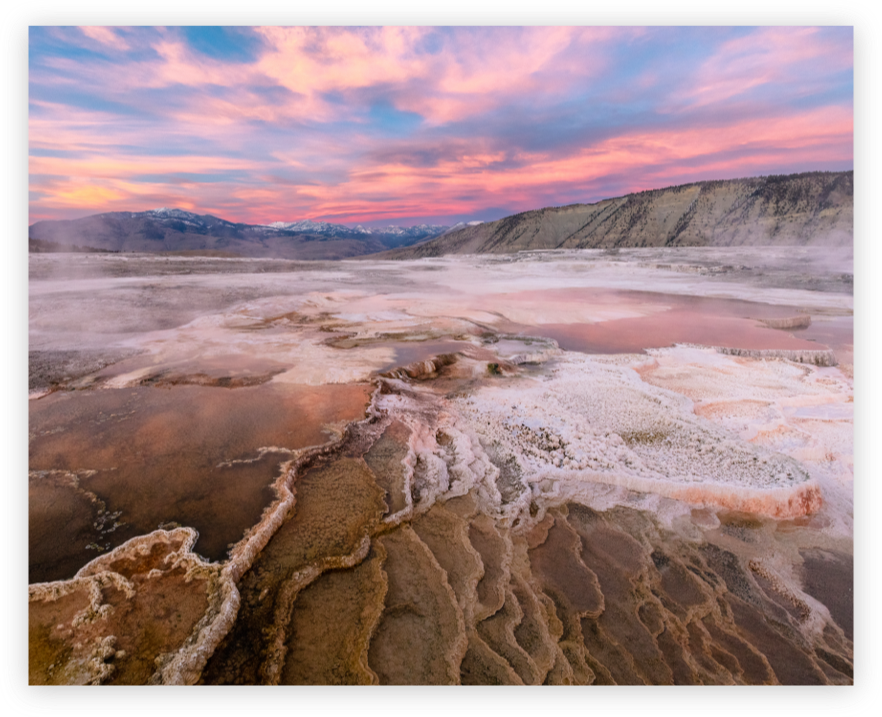
Sunset over travertine pools near Canary Springs (wide). Photo Courtesy of NPS / Jacob W. Frank
He’d caught the bug. After Denali, Frank got a job as social media manager and videographer with Navajo youth in Arizona through AmeriCorps, while his then-girlfriend Corrie stayed in Alaska mushing dogs. The next summer, she joined him in Rocky Mountain National Park, and the following winter Frank finally made his way back to Yellowstone. His job had him working out of a FEMA trailer while the Albright Visitor Center was being renovated, and that’s when he met Neal Herbert, another photographer and videographer for Yellowstone who became a mentor to him and whom he would shadow whenever Herbert needed a second shooter.
This job was also seasonal, but Frank was biding his time and trying to string together enough seasonal stints to qualify for the more competitive permanent jobs in the Park Service. After that winter, he got his break. Frank was hired by Glacier National Park to work in digital communications, and this position was permanent. He worked there for 18 months, until a spot as videographer and photographer in Yellowstone opened and he returned to the national park he’d grown up visiting as a kid. This time, he was there to stay.
During Frank’s third official year as the digital communications specialist for Yellowstone, the Park flooded. An atmospheric river combined with fast-melting mountain snows to cause what scientists called a thousand-year event, tearing homes from their moorings, gouging chunks out of highways, and carrying thousand-pound boulders for miles. On June 14, 2022, the Park Service evacuated 10,000 visitors from Yellowstone as the waters raged on, and Frank said that once everyone was safe, they realized, “We need to get out there.”
This job was also seasonal, but Frank was biding his time and trying to string together enough seasonal stints to qualify for the more competitive permanent jobs in the Park Service. After that winter, he got his break. Frank was hired by Glacier National Park to work in digital communications, and this position was permanent. He worked there for 18 months, until a spot as videographer and photographer in Yellowstone opened and he returned to the national park he’d grown up visiting as a kid. This time, he was there to stay.
During Frank’s third official year as the digital communications specialist for Yellowstone, the Park flooded. An atmospheric river combined with fast-melting mountain snows to cause what scientists called a thousand-year event, tearing homes from their moorings, gouging chunks out of highways, and carrying thousand-pound boulders for miles. On June 14, 2022, the Park Service evacuated 10,000 visitors from Yellowstone as the waters raged on, and Frank said that once everyone was safe, they realized, “We need to get out there.”
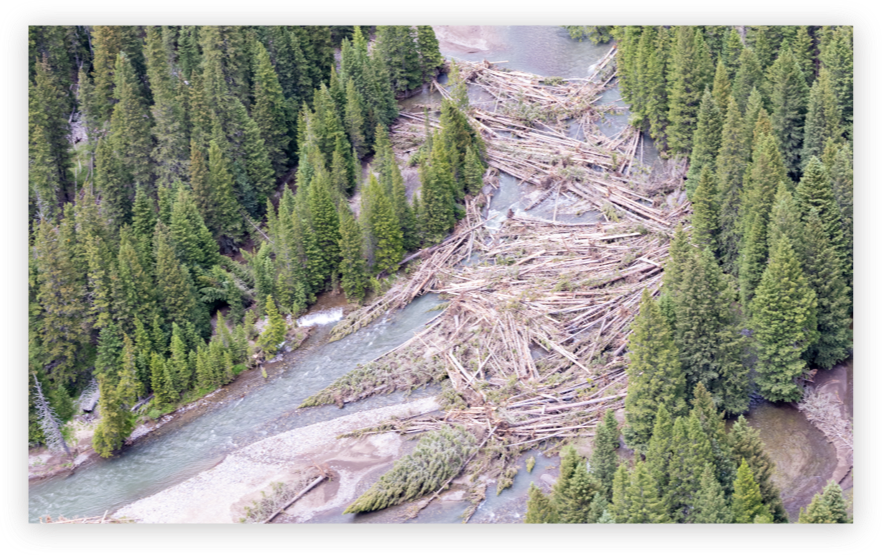
[FLOOD 1: RIVER FROM DISTANCE JAMMED WITH LOGS] Logjams deposited by Yellowstone’s historic flood in 2022.
A helicopter carrying Frank, his camera, and several others launched from Mammoth Hot Springs to check the status of two cabins near the river that were in danger of being swept away, and once the bird was in the air, Frank could see the true scale of the flood’s devastation.
“I grew up in Florida and I’ve been in a bunch of hurricanes…but to see a river and trees just crashing down, and the sound of these boulders that are bigger than cars, and you can hear them and feel the ground shaking as the boulders are tumbling down—it’s pretty humbling to see all that stuff,” Frank said. He remembers flying by Osprey Falls in the helicopter, but the water was no longer falling—it was shooting from the mouth of the river out into space. “Everything up here was going gnarly,” Frank said.
“I grew up in Florida and I’ve been in a bunch of hurricanes…but to see a river and trees just crashing down, and the sound of these boulders that are bigger than cars, and you can hear them and feel the ground shaking as the boulders are tumbling down—it’s pretty humbling to see all that stuff,” Frank said. He remembers flying by Osprey Falls in the helicopter, but the water was no longer falling—it was shooting from the mouth of the river out into space. “Everything up here was going gnarly,” Frank said.
Of everything he’s done working in Yellowstone, Frank thinks that his coverage of the flood will be the thing that lasts. But he’s also taken tens of thousands of photos and videos all over the Park. Chances are pretty good that anyone browsing photos on the Park’s website, or who sees a picture of Yellowstone pop up in a news article, are looking at one of Frank’s images. He’s been to all four corners of Yellowstone, either for work or on backpacking excursions with his wife or friends, and his camera is never far from his reach. Through his job, Frank regularly follows biologists into the field to photograph the collaring of mountain lions, wolves, grizzlies, and other megafauna, and one of the first things he saw in the Park after being hired there full time was a bison collaring. After a bison gets darted, its head must be kept uphill so it burps out the gas in its multiple stomachs instead of getting bloated, and Jake was filming down near its head when the bison let out a big belch right into his face. “It smelled like fresh cut grass,” Frank said. “I was thinking it was going to smell bad, and I was like, ‘Oh wow, that smells really good!’”
Somewhat surprisingly, most of the wildlife photos Frank captures are happy accidents. Often, he’s on his way to some other assignment, like taking videos of new employee housing, when a wolf darts across the road and leaves him only a few seconds to whip out his camera and point it out the window for a photo. “I call it Yellowstone magic,” Frank said. “When you’re least expecting it, something crazy and amazing happens to you…and you just have to make sure that you’re ready.”
Most of Frank’s work in the Park focuses not on the wildlife or the landscape, but on everything that goes on behind the scenes to make it tick. Frank works closely with Cam Sholly, Yellowstone’s superintendent, to determine which stories to tell, and often that means covering little-known corners of the Park that don’t often see the spotlight. “One of my favorite parts of my job is to shine a spotlight on all the people and work and everything that takes place,” Frank said.
Most of Frank’s work in the Park focuses not on the wildlife or the landscape, but on everything that goes on behind the scenes to make it tick. Frank works closely with Cam Sholly, Yellowstone’s superintendent, to determine which stories to tell, and often that means covering little-known corners of the Park that don’t often see the spotlight. “One of my favorite parts of my job is to shine a spotlight on all the people and work and everything that takes place,” Frank said.
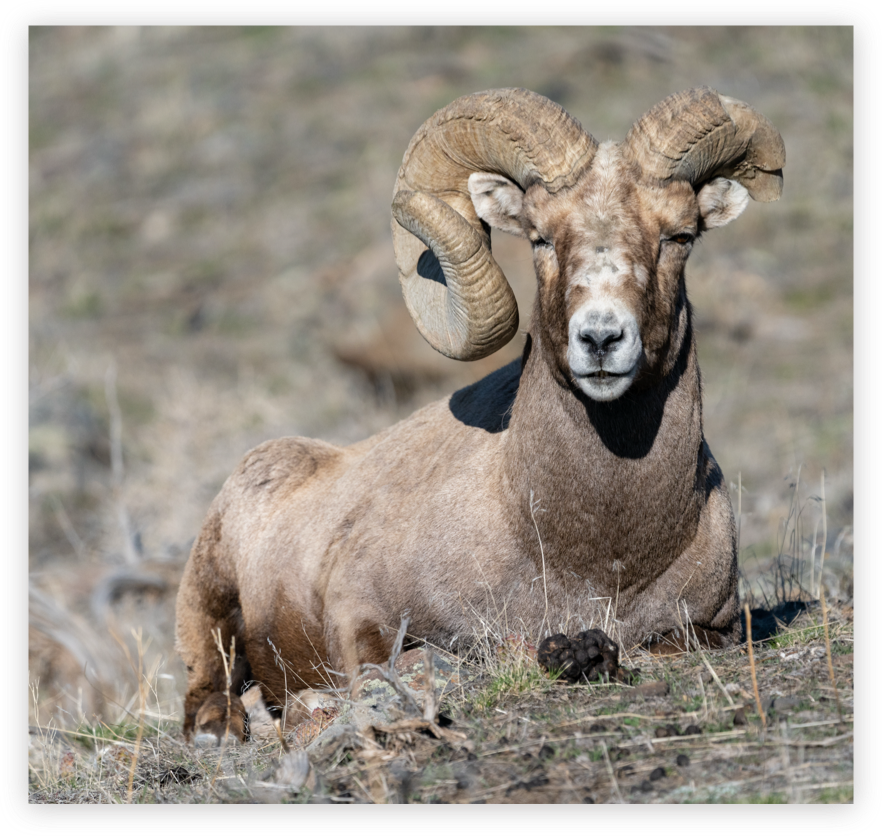
[BIGHORN SHEEP WITH ONLY ONE HORN] The most unique ram Frank’s ever seen, photographed off the side of one of Yellowstone’s main roads.
He talks about the 175-plus toilets that must be cleaned and maintained in the Park, Yellowstone’s sizable wastewater treatment plant, and everything else required to support the 30,000ish people that spend the night in Yellowstone each night during the summer. Frank remembers telling his friend Dave Whaley that he couldn’t believe how much infrastructure there was in the Park. “Yup,” Whaley replied. “There’s a whole lot of stuff that goes into just making sure that somebody can come and take a picture of a bear.”
To Frank, the goal of everyone in Yellowstone is to allow that interaction to happen, in a way that’s safe for both the bear and the person taking its photo. “It’d be really easy to protect Yellowstone if you just said, ‘Hey, no one’s allowed to come in here,’ and then it just kind of takes care of itself,” Frank said. “But I think our job is that dual mandate of the Park Service: to preserve it, but then also allow people to enjoy it at the same time.”
That’s the mission. “This is a relay race, and we have the baton right now,” Frank said. “But when you came here, someone passed it off to you, and then you’re going to pass it off to somebody else, and this has been going on for 154 years. Our goal is, ultimately, to work for the American people and to protect this thing that belongs to everybody, so that when they come and visit, they have a memorable experience. Hopefully we can just keep that going in perpetuity.”
As someone who came there for the first time as a three-year-old, Frank knows that better than anyone.
To Frank, the goal of everyone in Yellowstone is to allow that interaction to happen, in a way that’s safe for both the bear and the person taking its photo. “It’d be really easy to protect Yellowstone if you just said, ‘Hey, no one’s allowed to come in here,’ and then it just kind of takes care of itself,” Frank said. “But I think our job is that dual mandate of the Park Service: to preserve it, but then also allow people to enjoy it at the same time.”
That’s the mission. “This is a relay race, and we have the baton right now,” Frank said. “But when you came here, someone passed it off to you, and then you’re going to pass it off to somebody else, and this has been going on for 154 years. Our goal is, ultimately, to work for the American people and to protect this thing that belongs to everybody, so that when they come and visit, they have a memorable experience. Hopefully we can just keep that going in perpetuity.”
As someone who came there for the first time as a three-year-old, Frank knows that better than anyone.